When most people hear the word vanilla, they think of ice cream, baking, or the fragrant beans used to flavor food. What many people do not realize is that vanilla comes from an orchid, and Florida has native vanilla orchids of its own. One of the most remarkable is Vanilla phaeantha, the leafy vanilla orchid, a tropical climbing species native to South Florida.
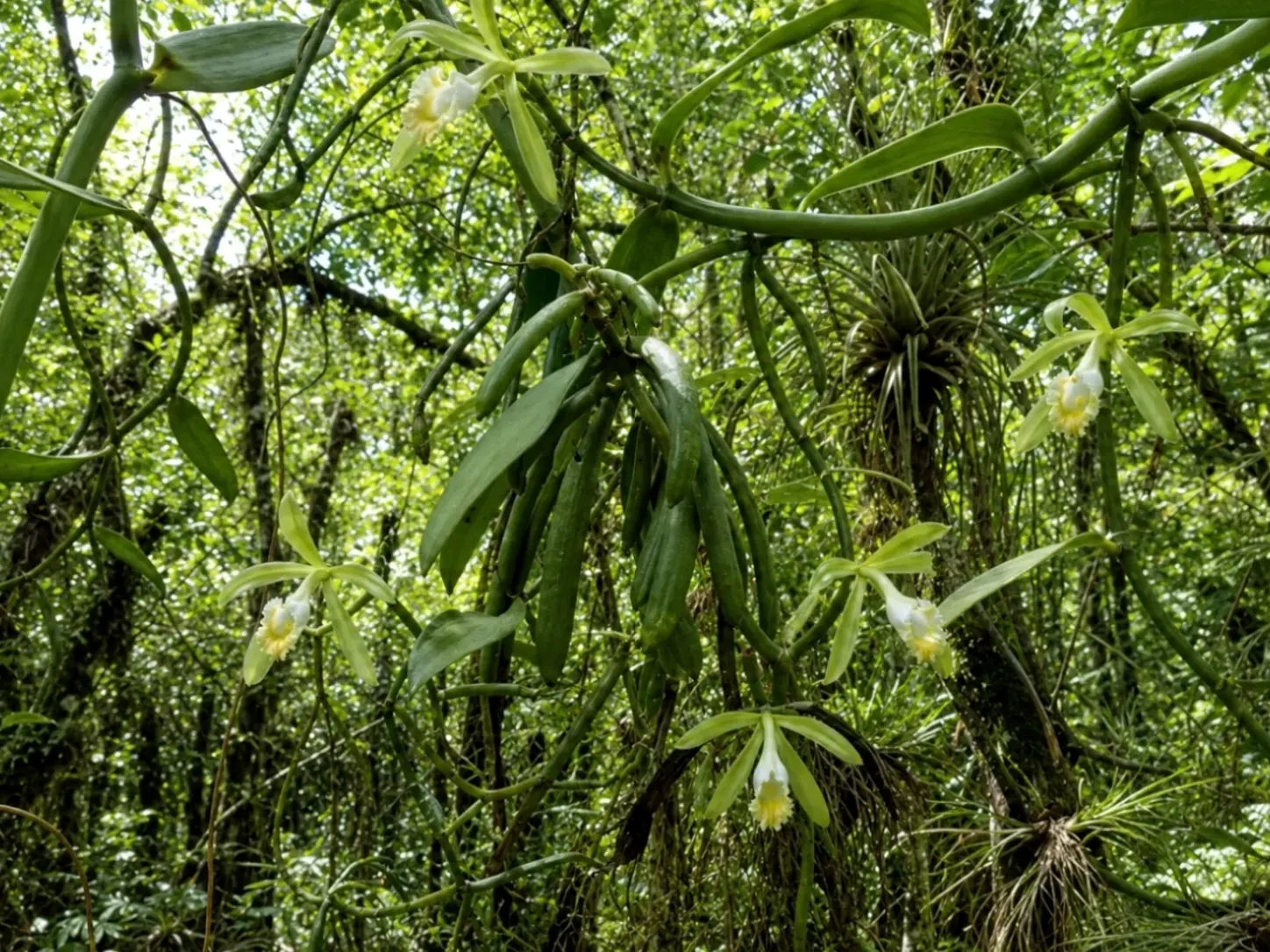
In Florida, Vanilla phaeantha occurs in the southern part of the peninsula, particularly in wet, shaded environments such as cypress swamps, sloughs, and tropical hardwood hammocks. It is especially associated with the extraordinary orchid habitat of Southwest Florida, including the Fakahatchee Strand. Its wild populations are rare enough that the species is listed as endangered in Florida.
Florida Has Only Four Native Vanilla Species
- Vanilla barbellata — Barbed-lip vanilla, also called worm-vine orchid.
- Vanilla dilloniana — Dillon’s vanilla, a largely leafless climbing species.
- Vanilla phaeantha — Leafy vanilla, the species featured in this article.
- Vanilla mexicana — Fuchs’ vanilla, also called scentless vanilla.
Those four species represent Florida’s native members of one of the world’s most recognizable orchid genera. UF/IFAS identifies V. barbellata, V. dilloniana, V. phaeantha, and V. mexicana as Florida’s four native vanilla species. All four are endangered in the state and should not be collected from natural areas without the appropriate authorization and permits.
Commercial vanilla, Vanilla planifolia, is different. It is the species most commonly cultivated for vanilla flavoring and is not one of Florida’s four native species. It has become naturalized in a few parts of South Florida after cultivation.
A Native Orchid That Climbs Like a Vine
Vanilla phaeantha looks very different from the orchids many people know from nurseries and grocery stores. Instead of forming a compact cluster of leaves, it grows as a long climbing vine.
Young plants begin near the forest floor among decaying organic material. As the vine grows, it reaches nearby trees and begins climbing upward. Aerial roots develop along the stem and attach themselves tightly to bark.
Over time, the oldest terrestrial portion of the vine may die away, leaving the upper plant growing as an epiphyte attached to the tree. Mature vines can become extremely long as they wind through the shaded forest and climb toward areas where more light reaches the canopy.
Unlike Florida’s largely leafless vanilla species, Vanilla phaeantha carries thick, oblong green leaves along its stem. Those leaves make the vine much easier to recognize when it is growing high on a tree.
Florida’s native vanilla orchids are not tropical curiosities planted by people. They are part of the state’s original botanical heritage.
A Flower That May Last Only One Day
When a mature leafy vanilla orchid receives enough light and the right environmental conditions, flower buds develop from the vine. In much of its range, Vanilla phaeantha typically flowers during June and July, although plants in Southwest Florida have sometimes been observed flowering earlier in spring.
The flowers are large, pale green to greenish-yellow, with a striking tubular white lip marked with yellow. Individual flowers are short lived.
A flower may open in the morning and begin fading by afternoon. If pollination does not occur during that narrow window, the flower eventually collapses and falls.
If pollination is successful, the ovary behind the flower begins to swell and develop into the elongated seed capsule commonly called a vanilla bean.
Despite the familiar name, wild Florida vanilla orchids should never be treated as a source of culinary vanilla. Their conservation value is far greater than any possible use of an individual seed capsule.
Pollination Is Still Part of the Mystery
The pollination biology of Florida’s native vanilla orchids is not fully understood. Older accounts sometimes attribute vanilla pollination specifically to Melipona bees, but current orchid references do not identify a confirmed pollinator for Vanilla phaeantha, but it is thought that specific small Melipona bees and male Euglossine orchid bees help pollinate them.
Across the genus, vanilla orchids are often associated with large Euglossine bees and other tropical pollination relationships. Florida’s native populations occur near the northern edge of the genus’s natural range, making their reproductive ecology especially interesting for future research.
Understanding which insects successfully pollinate wild Florida vanilla flowers could eventually become an important part of protecting and restoring their populations.
Why Orchid Seeds Are So Different
Orchid seeds are among the smallest seeds produced by flowering plants. A mature orchid capsule can contain enormous numbers of dust-like seeds, but each individual seed contains almost none of the stored food reserves found in larger seeds.
That creates an unusual problem. A tiny orchid embryo cannot simply fall onto the ground, absorb water, and grow the way many other seeds can.
In nature, orchid germination commonly depends on compatible mycorrhizal fungi. The fungus enters into a relationship with the developing orchid and helps provide nutrients during the earliest stages of growth.
This means conserving an orchid is more complicated than preserving a seed alone. The tree, the surrounding habitat, the fungi, moisture, light, pollinators, and other ecological relationships may all be part of what allows that seed to become another mature orchid.
What Native Vanilla Seed Conservation Could Support
- Documented seed collections from legally authorized wild populations.
- Preservation of genetic diversity from multiple parent plants.
- Long-term freezer storage when the biology of the species allows it.
- Germination and viability testing.
- Research into compatible mycorrhizal fungi.
- Laboratory and nursery propagation.
- Future restoration of protected South Florida habitat.
- A safeguard against hurricanes, habitat loss, poaching, and population decline.
Why Four Species Matter
The fact that Florida has only four native vanilla species makes every one of them especially important.
Vanilla barbellata survives in South Florida coastal and brackish wetlands. Vanilla mexicana occurs in southeastern Florida but is considered highly rare in the state. Vanilla phaeantha survives primarily in the wet forests of South Florida.
Vanilla dilloniana may be the most precarious of all. Historical records place it in South Florida, including areas around the Miami River, but modern orchid references indicate that it may now be extirpated from Florida’s wild landscape. Plants descended from the historic Florida population may still survive in cultivation.
That possibility is a powerful example of why conservation must begin before a species reaches its final wild plants.
Once the last natural population disappears, conservation becomes dramatically harder. Seeds, documented living collections, herbarium records, propagation material, and genetic samples may become the only biological connection to what once grew naturally in the state.
Habitat Is as Important as the Seed
Seed banking cannot replace habitat protection.
A future Vanilla phaeantha seedling needs somewhere to live. It needs the humid conditions of South Florida, compatible fungi, suitable trees to climb, the right light conditions, adequate moisture, and an ecosystem capable of supporting pollinators and future reproduction.
Cypress swamps, tropical hardwood hammocks, sloughs, coastal wetlands, and other South Florida habitats have been fragmented or altered by development, drainage, invasive species, storms, and changing environmental conditions.
Protecting the genetic material of a species while losing every place that species can live would only preserve half of the solution.
All four native Florida vanilla orchid species are endangered in the state. Plants, roots, flowers, seed capsules, or other material should only be collected when legally authorized and scientifically appropriate. Conservation collection should protect the wild population, not reduce it.
Florida Seed Bank collects rare or endangered plant material only when the work is legally authorized, scientifically appropriate, and supported by the permits, land-management approval, documentation, propagation knowledge, and professional expertise required for the species and site.
Preserving Florida’s Hidden Vanilla Orchids
A leafy vanilla vine climbing through a South Florida swamp may be easy to overlook until it produces one enormous pale green flower for a few hours on a summer morning.
But plants like Vanilla phaeantha are exactly why native seed conservation matters.
Florida’s biodiversity is not made up only of abundant plants. It also includes rare species surviving in isolated hammocks, wetlands, pine forests, coastal habitats, and swamps. Some exist in only a handful of places. Others have already vanished from areas where they once grew.
Carefully documented seed banking gives conservationists another tool for preventing those losses from becoming permanent. Preserved seed can support future research, propagation, genetic study, restoration, and the rebuilding of populations after catastrophic loss.
For orchids, that work must go further by including fungi, host trees, habitat, pollinators, and propagation expertise. But the principle remains the same: preserve as much biological possibility as possible while it still exists.
Florida has only four native vanilla orchid species. Protecting them means ensuring that future generations can know them not simply as names in botanical records or plants behind greenhouse glass, but as living vines still climbing through Florida’s wild forests.