Conservation Resilience
A Reservoir of Florida Genetic Diversity
A seed bank is more than cold storage. Each viable, documented accession
represents genetic options that remain available even if the original
population is later damaged or lost.
Hurricanes, development, flooding, fire, invasive species, altered hydrology,
disease, equipment failure, and other disruptions can affect both wild
populations and conservation facilities. Florida Seed Bank reduces that risk
by pairing provenance records with long-term storage, viability monitoring,
regeneration, and geographically separated duplicate material whenever
practical.
The goal is resilience: no scientifically important population should depend
on a single wild site, a single freezer, or a single copy of its conservation
record.
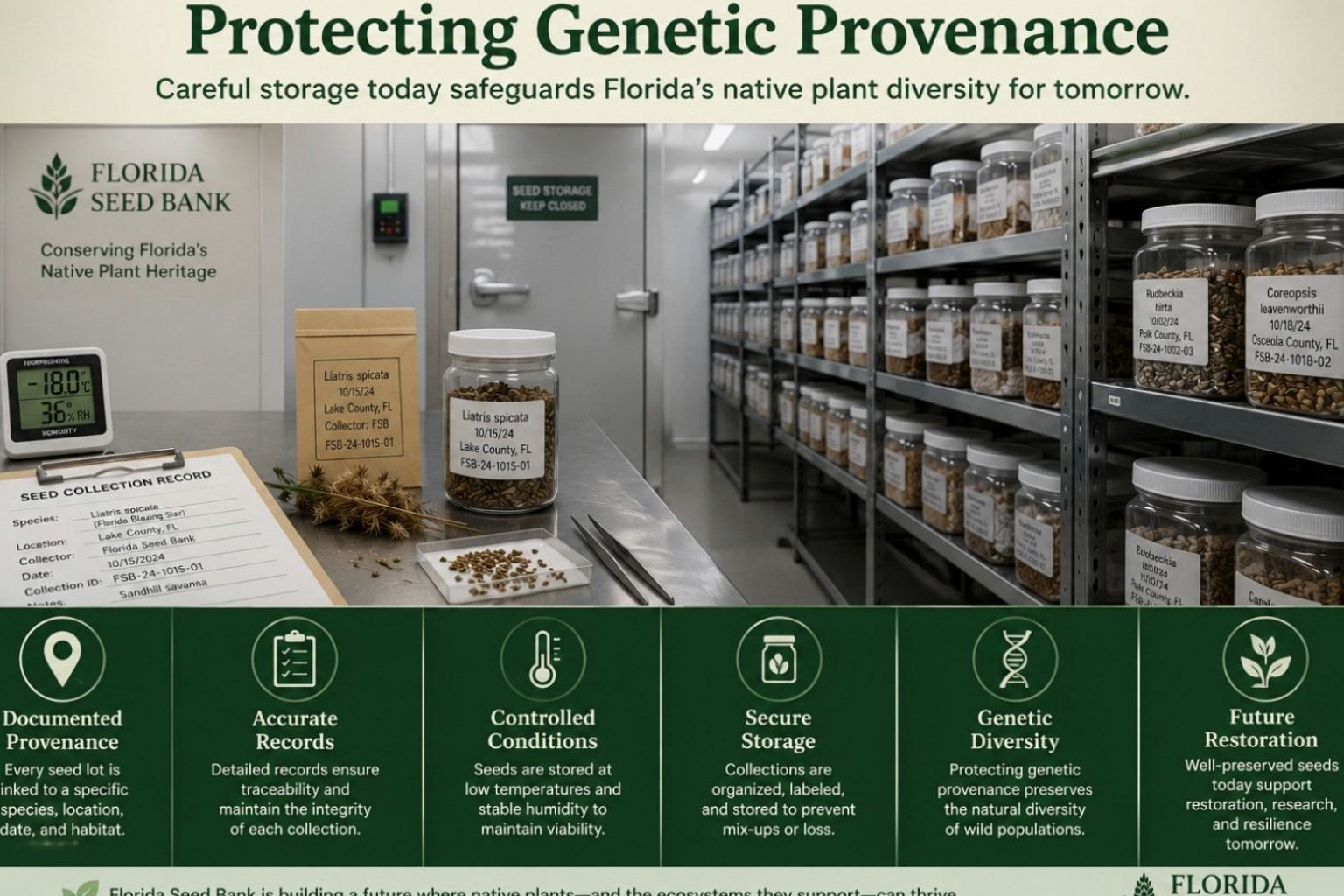
Accession Documentation
What Travels With an Accession
Every accession remains connected to the scientific record that gives the
seed meaning and future conservation value.
01
Taxonomic Identity
The documented species or taxon.
02
Source Population
The population from which material originated.
03
Collection Date
When the material was gathered.
04
Habitat Context
Ecosystem, associated conditions, and relevant site observations.
05
Regional Provenance
The geographic origin needed to avoid treating distinct Florida
populations as interchangeable.
06
Site-Level Provenance
Detailed location records when appropriate, with sensitive locations
protected from public disclosure.
07
Processing History
Cleaning, drying, packaging, storage, and treatment information.
08
Viability History
Germination tests, monitoring dates, and regeneration needs.
09
Duplicate Storage
Where backup material is maintained when geographic duplication is used.
Long-Term Stewardship
Long-Term Conservation Storage
Species that tolerate conventional seed banking move through a controlled
preparation and storage process. Seed is carefully cleaned to remove debris
and damaged material, then dried to a species-appropriate moisture level before
being sealed in moisture-resistant or hermetic archival packaging.
Conventional long-term conservation collections are maintained at approximately
−20 °C when that storage method is biologically appropriate
for the species. Freezer temperature is monitored, accessions remain tied to
their provenance records, and viability testing is used to determine whether
stored material remains capable of germination.
Florida Seed Bank does not use a universal seed-count target for every accession.
Appropriate collection size depends on population size, seed biology, reproductive
output, conservation objectives, permits, and the need to leave enough seed for
natural regeneration and wildlife.
Duplicate conservation material can be maintained in geographically separated
facilities so a hurricane, flood, fire, freezer failure, extended power outage,
or other local disaster cannot eliminate the only stored copy of a population.
Conservation Workflow
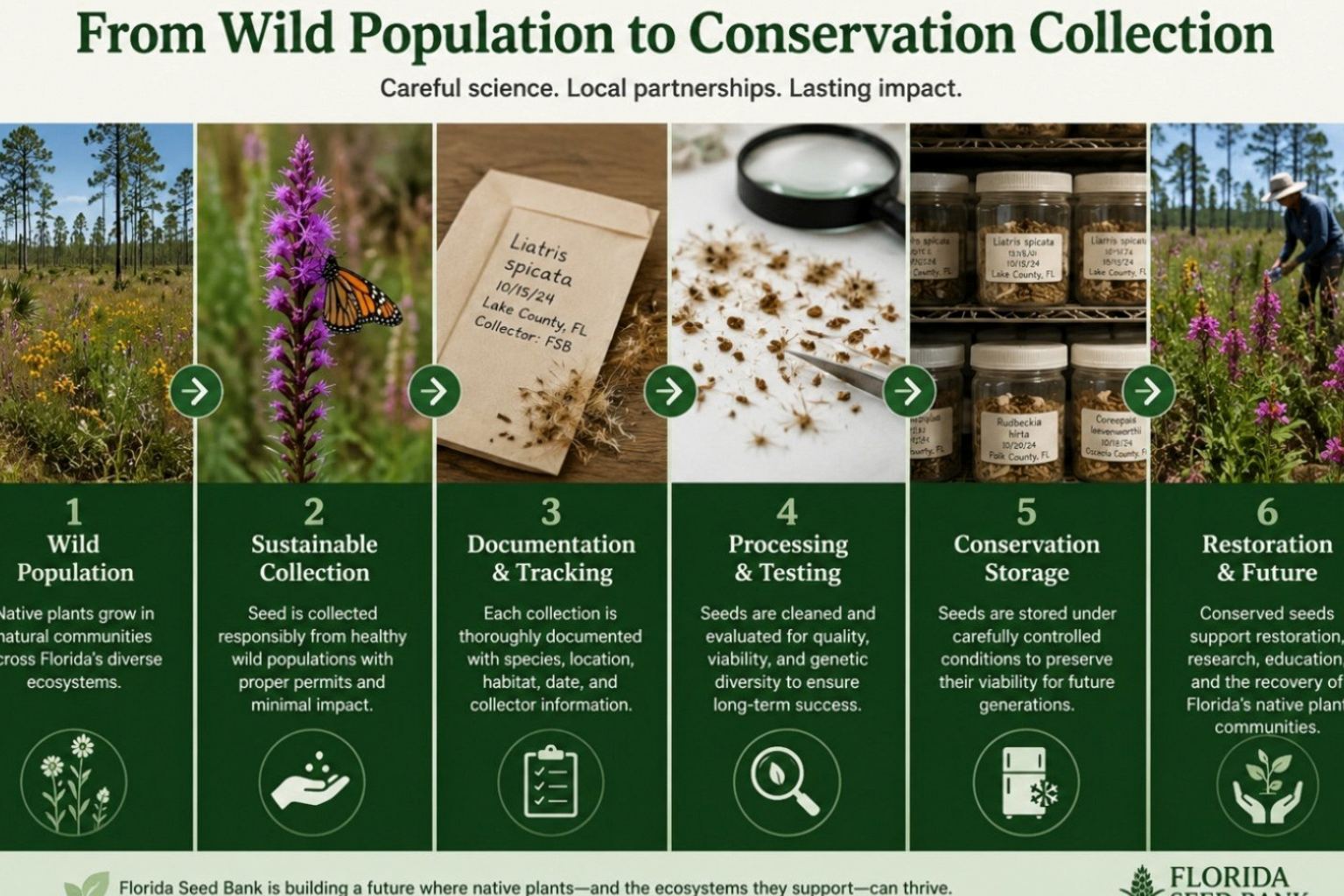
From Wild Population to Genetic Resource
A documented accession moves through a deliberate sequence from responsible
collection to long-term conservation and eventual use.
01
Collect
Ethically and legally sample appropriate source populations.
02
Document
Record identity, location, habitat, date, source population, and provenance.
03
Clean
Remove debris, damaged seed, and non-seed material.
04
Dry When Appropriate
Reduce moisture for species that tolerate conventional seed banking.
05
Package
Seal material in moisture-resistant or hermetic archival containers.
06
Store
Use approximately −20 °C conservation storage for suitable orthodox seed,
or a species-specific alternative.
07
Duplicate
Maintain geographically separated backup material when practical.
08
Test Viability
Monitor whether stored seed remains capable of germination.
09
Regenerate or Amplify
Produce new seed when conservation biology and accession condition require it.
10
Restore or Use
Make documented genetic material available for appropriate research,
propagation, restoration, or recovery work.
Species-Specific Conservation
Different Seeds Require Different Solutions
Not every Florida native plant can be conserved using the same storage method.
Some seeds tolerate drying and cold storage well, while others require specialized
approaches. Our conservation program matches preservation methods to the biological
needs of each species.
Conventional Seed Banking
Species whose seeds tolerate drying and low-temperature storage may be
preserved in carefully controlled long-term conservation storage.
Specialized Conservation
Species with unusual seed biology may require living collections,
specialized propagation, tissue culture, cryopreservation partnerships,
or other approaches.
Geographic Backup
Where seed quantity and biology permit, important collections can be
duplicated at a geographically separate location to reduce the risk of
catastrophic loss.