The mule ear orchid, scientifically known as Trichocentrum undulatum, is one of the most striking native orchids associated with South Florida. Its broad, leathery leaves and tall sprays of yellow, brown, and wine-colored flowers make it difficult to overlook. Yet in Florida, this dramatic plant has become perilously easy to lose.
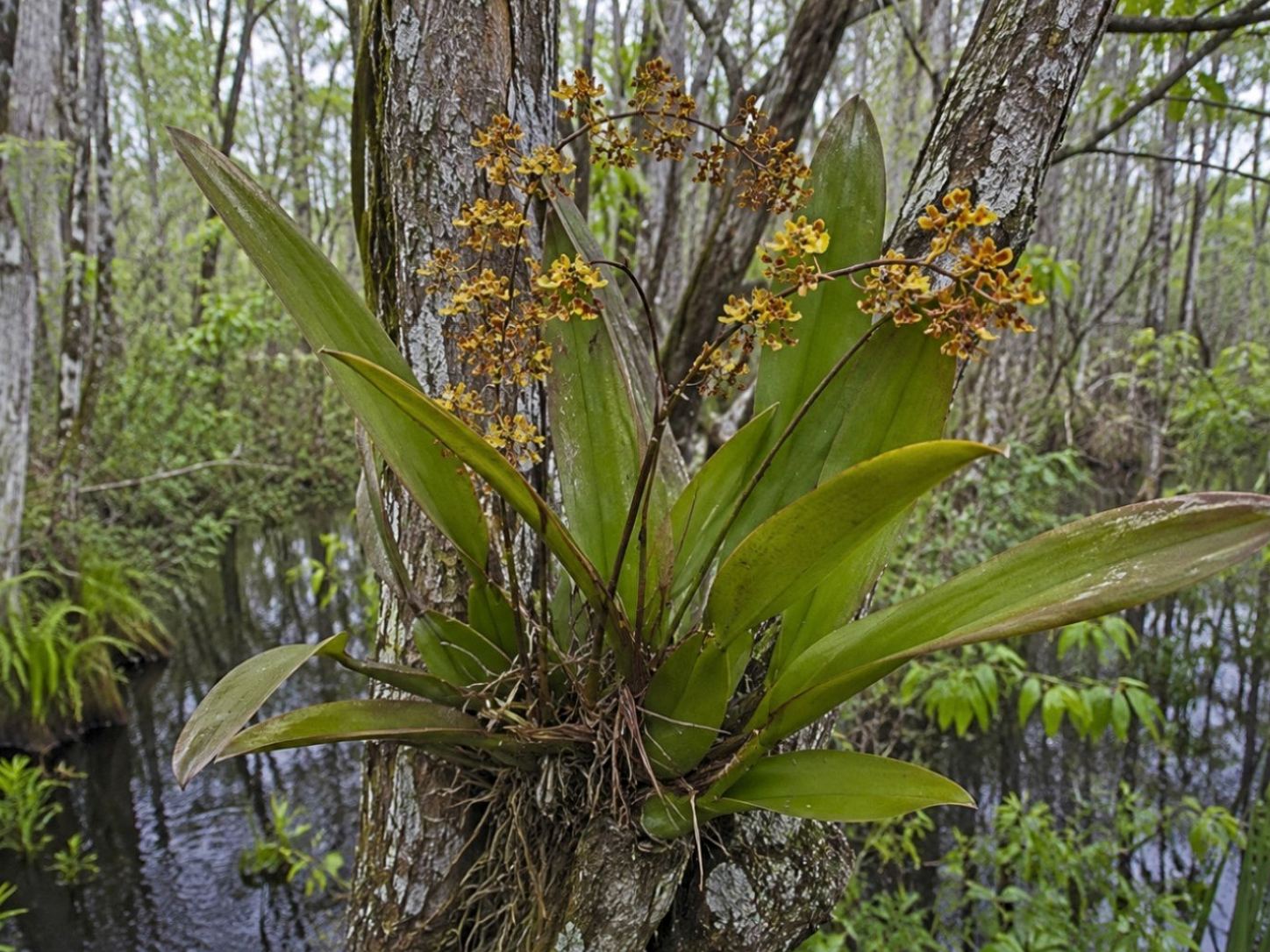
Research led by Florida International University found that the orchid’s northernmost population has been reduced to one known location in the southern Everglades. During the study, researchers located fewer than 300 plants there. When a population is already this small and geographically isolated, the loss of even a few mature individuals can reduce future flowering, seed production, and genetic diversity.
Why Florida’s Population Is So Vulnerable
- The known U.S. population is restricted to one remote South Florida location.
- Hurricanes and storm surge can break host branches, damage coastal forest, and kill established orchids.
- Historical poaching and habitat loss reduced native orchid populations across South Florida.
- An invasive armored scale insect can infest leaves, weaken plants, and cause death.
- A specialist fly damages flowering stalks and may further reduce successful reproduction.
A Native Orchid Under Pressure From Every Direction
Mule ear orchids grow as epiphytes, meaning they live on trees without taking nutrients from them as parasites. In Florida, the remaining orchids are associated with coastal buttonwood habitat in the Everglades. That narrow habitat leaves the population exposed to hurricanes, flooding, saltwater intrusion, forest change, and the loss of suitable host trees.
Hurricanes are an obvious threat, but researchers identified a much smaller invader as an especially serious source of mortality. Boisduval scale, an invasive armored scale insect, attaches to orchid leaves and feeds on the plant. Heavy infestations leave pale material across the leaf surface, weaken the orchid, and can eventually kill it.
FIU researchers found that scale-infested orchids were more likely to die. When they returned to areas where affected plants had been documented two years earlier, many of those orchids were gone. Cuba’s larger mule ear orchid populations provided an important comparison: researchers did not find the invasive scale at the Cuban study locations.
Florida’s plants also contend with a fly whose larvae feed inside the flower stalk. Although this damage may not kill the entire orchid, injury to a flowering stem can interfere with reproduction. In a population with so few adults, every lost flowering opportunity matters.
When only one small population remains, conservation cannot depend on the hope that every hurricane, pest outbreak, and habitat change will pass without permanent loss.
Why Collecting Orchid Seed Can Make a Difference
A carefully planned seed collection can preserve genetic material even if individual wild plants later die. Orchid seeds are exceptionally small and dry. Researchers studying the mule ear orchid have noted that its seeds can tolerate freezing well, making authorized collection and long-term freezer storage a promising form of biological insurance.
The goal is not simply to place seed in a container and forget it. A useful conservation collection must be connected to the identity and history of the parent population. That means recording the source location, collection date, habitat, host tree, parent plants, seed maturity, handling methods, and any available information about disease or insect pressure.
Collecting from multiple healthy plants, when legally permitted and biologically appropriate, can also capture more of the population’s remaining genetic diversity. That diversity may influence disease resistance, flowering, climate tolerance, and the ability of future plants to adapt to changing conditions.
What a Mule Ear Orchid Seed Program Could Support
- Long-term freezer storage of documented seed collections.
- Periodic germination and viability testing.
- Laboratory and nursery propagation of genetically diverse plants.
- Research into germination, fungi, host trees, pests, and habitat requirements.
- Carefully planned outplanting to strengthen or expand protected wild populations.
- A safeguard against catastrophic loss from storms, invasive insects, or habitat decline.
Storage Is Only the Beginning
Orchid seed banking is especially valuable because a very large number of dust-like seeds can be preserved in a small amount of freezer space. But preserving seed is only one part of recovering a rare orchid.
Orchid seeds contain very little stored nutrition and require specialized conditions to germinate. In nature, orchids commonly depend on relationships with compatible fungi. In conservation programs, seeds may be raised under controlled laboratory or nursery conditions until young plants are strong enough for carefully managed outplanting.
Researchers have proposed using propagated orchids to reinforce the existing population and potentially establish plants in other protected South Florida habitats with suitable trees and environmental conditions. Expanding beyond a single site could reduce the risk that one hurricane, disease event, pest outbreak, or local habitat change erases Florida’s entire population.
Seed Banks Need Freezers, Expertise, and Protected Land
The mule ear orchid is an example of why conservation infrastructure must extend beyond collecting seed. Long-term work requires dedicated seed-bank freezers, moisture-resistant packaging, temperature monitoring, backup power, viability testing, accurate records, propagation facilities, trained specialists, and secure conservation infrastructure.
It also requires protected habitat. Seedlings raised from stored seed eventually need appropriate host trees, suitable fungi, hydrology, light, humidity, and long-term protection. Freezer storage preserves future options, while nursery propagation and protected land turn those options into living plants.
Some Florida species cannot tolerate conventional drying and freezing at all and must instead be maintained through living collections or periodically renewed propagation plots. A statewide seed conservation program therefore needs both cold storage and land-based capacity.
Seed, plants, or plant material should only be collected with the landowner’s permission and every required state, federal, or land-management authorization. For a population this small, Florida Seed Bank treats collection as specialized conservation work requiring scientific planning, careful documentation, appropriate expertise, and a clear population-level conservation purpose.
Preserving the Next Generation Before It Disappears
Florida’s mule ear orchid has survived hurricanes, historic collecting, habitat destruction, and invasive insects. Its continued survival should not depend on luck.
Authorized seed collection can preserve the genetic legacy of remaining plants while researchers address pests, identify suitable habitat, develop propagation methods, and plan restoration. Stored seed gives conservationists something increasingly rare in an ecological emergency: time.
The lesson reaches far beyond one orchid. When a native plant population becomes small, isolated, and vulnerable, waiting until the last few specimens remain makes every recovery effort more difficult. Ethical seed banking allows Florida to act earlier—preserving the possibility of future research, propagation, and restoration before an irreplaceable population disappears.