Central Florida is often associated with lakes, citrus groves, suburbs, and rapidly growing cities. But scattered across the interior are remnants of an ecosystem that is much older than modern Florida itself: the Florida scrub.
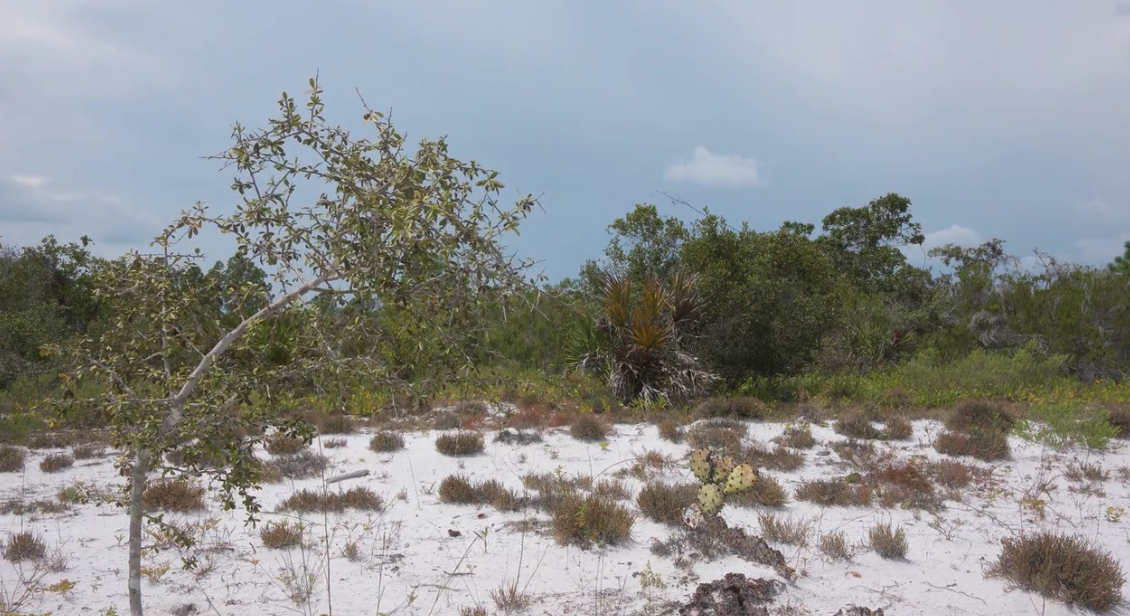
Florida scrub occurs on ancient sandy ridges and former dune systems. Some of the best-known examples are found along the Lake Wales Ridge, a narrow band of high sandy ground running through parts of Polk and Highlands counties.
The landscape can look sparse compared with a forest or wetland. Open patches of pale sand separate low scrub oaks, palmettos, Florida rosemary, sand pine, and small flowering plants. But beneath that seemingly simple appearance is an ecosystem with exceptional biological importance.
Many scrub plants have extremely limited ranges. Some occur primarily, or entirely, on the Lake Wales Ridge. That makes Central Florida scrub not just another plant community, but one of the most important centers of endemism in the state.
What Makes Florida Scrub Different
- Scrub grows on deep, rapidly draining, nutrient-poor sandy soils.
- Plants must tolerate drought, extreme heat, intense sunlight, and periodic fire.
- Open patches of bare sand are a natural and important part of healthy scrub habitat.
- Scrub oaks, Florida rosemary, sand pine, scrub palmetto, and specialized wildflowers are characteristic plants.
- The Lake Wales Ridge supports rare species found in few other places on Earth.
A Landscape Built on Ancient Sand
Florida’s scrublands occur on some of the driest soils in the state. Rain may fall heavily, but water drains quickly through the deep sand, leaving plants exposed to drought conditions soon afterward.
Nutrients also wash rapidly through these soils. Plants that survive here have evolved ways to conserve water, tolerate heat, and compete in an environment where moisture and fertility are limited.
Scrub oaks often have thick or curled leaves that reduce water loss. Florida rosemary, Ceratiola ericoides, has narrow leaves and extensive roots. Saw palmetto and scrub palmetto grow close to the ground and can persist through harsh conditions.
Sand pine, Pinus clausa, may rise over some scrub communities, while other areas remain almost entirely shrub-dominated.
Florida scrub can look empty at first glance, but its open sand and low vegetation support species that may exist nowhere else in the world.
The Lake Wales Ridge: A Center of Florida Endemism
The Lake Wales Ridge is one of Florida’s most biologically distinctive regions. Archbold Biological Station describes it as a biodiversity hotspot formed from ancient sand dunes and home to rare plants and animals adapted to the scrub ecosystem.
Plant conservation research on the ridge focuses heavily on species that occur nowhere else, including federally and state-listed plants whose entire global distributions may be restricted to small areas of Central Florida.
One example is Highlands scrub hypericum, Hypericum cumulicola. The Florida Natural Areas Inventory identifies it as endemic to the Lake Wales Ridge, where it grows in open patches of white sand and rosemary scrub.
Its survival depends on something that can look destructive from the outside but is essential to the ecosystem: fire.
Fire Keeps the Scrub Open
Like the longleaf pine savannas of North Florida, Central Florida scrub is a fire-shaped ecosystem.
Fire intervals vary depending on the type of scrub, soil, and moisture conditions. Some communities may burn on relatively short cycles, while others can go decades between major fires.
When fire moves through scrub, many woody shrubs are top-killed but can resprout from underground structures. Other plants, including sand pine and Florida rosemary, may be killed completely and regenerate from seed.
Fire also removes accumulated litter and dense vegetation, restoring patches of open sand where many rare scrub plants germinate and grow.
Without enough fire, scrub becomes increasingly dense. Trees and shrubs close in, bare sand disappears, sunlight becomes more limited, and populations of specialized scrub plants can decline.
What Central Florida Scrub Seed Conservation Can Protect
- Genetics from rare Lake Wales Ridge plant populations.
- Seed from locally adapted scrub oaks and shrubs.
- Fire-dependent wildflowers that rely on open sandy habitat.
- Plants adapted to extreme drought and nutrient-poor soils.
- Seed needed for future scrub restoration projects.
- Genetic differences among isolated scrub fragments.
- Reference collections documenting where native populations originated.
Why Bare Sand Matters
In many landscapes, exposed soil is interpreted as damage. In Florida scrub, open sand can be a sign of ecological health.
Healthy scrub includes breaks between shrubs where sunlight reaches the ground and patches of bare white or yellow sand remain exposed.
Those openings provide habitat for small flowering plants, insects, reptiles, and other species that cannot survive once shrubs become too dense.
Florida scrub lizards, for example, are strongly associated with open sandy areas maintained by fire and other natural disturbance.
Many rare plants are similarly dependent on these openings. Preserving scrub therefore means protecting not only the plants themselves, but the physical structure of the habitat.
Development Has Fragmented the Ridge
Central Florida’s higher sandy ridges have also been attractive places for agriculture and development.
Citrus groves, cattle operations, roads, housing, mining, and other land uses have replaced or divided large areas of historic scrub.
FNAI reports that the habitat of Highlands scrub hypericum alone has experienced a long-term decline of more than 80 percent in the Lake Wales Ridge region because of development, citrus cultivation, cattle ranching, and mining.
Fragmentation creates another conservation challenge. Even when small patches remain, plant populations can become isolated from one another.
That isolation can make pollination, seed dispersal, gene flow, and natural recolonization more difficult.
Why Regional Seed Genetics Matter Here
Central Florida scrub demonstrates why a statewide seed bank cannot treat every population of a species as identical.
A plant growing for generations on the Lake Wales Ridge may carry genetic adaptations shaped by extreme heat, deep sand, drought, local pollinators, elevation, and a particular fire regime.
A population of the same species elsewhere in Florida may experience different rainfall patterns, soils, temperatures, and ecological pressures.
When seed is preserved for conservation and restoration, documenting its origin matters.
A useful seed accession should record where a population grew, what habitat surrounded it, when the seed was collected, and which parent plants contributed to the collection.
That information helps future restoration projects use seed that is ecologically appropriate for the place being restored.
Seed Banking and Fire Must Work Together
Preserving scrub seed in storage can protect genetic material against catastrophic loss, but storage alone cannot maintain a living scrub ecosystem.
Restoration requires suitable land, appropriate sandy soils, careful species selection, continued invasive species control, and the reintroduction of fire when ecologically appropriate.
Some scrub species also depend strongly on seed banks already present in the soil. After fire, dormant seeds may germinate as sunlight reaches the ground and competition is temporarily reduced.
This relationship between disturbance and regeneration is one reason seed ecology is so important in scrub conservation.
Many Central Florida scrub species occur in small, fragmented, or legally protected populations. Seed collection should only occur with landowner permission and every required state, federal, or land-management authorization. Conservation collection should preserve the population, not reduce its ability to reproduce naturally.
Protecting Florida From the Panhandle to the Ridge
Florida’s natural landscapes change dramatically from one region to another.
In Northwest Florida, longleaf pine savannas and pitcher plant prairies depend on fire and seasonal water. In South Florida, orchids and bromeliads grow in humid swamps and tropical forests. In Central Florida, ancient scrublands survive on some of the driest sand in the state.
Each region contains plant populations adapted to its own climate, soils, hydrology, fire history, and ecological relationships.
Preserving Florida’s botanical diversity therefore requires more than collecting a list of species. It requires conserving the genetic variation contained within populations across different regions.
Central Florida scrub is a powerful example of why that matters.
A rare plant growing on an isolated ridge may represent thousands of years of adaptation to one small part of Florida. Once that population disappears, the genetic history it carries may disappear with it.
The long-term goal of the Florida Seed Bank is to help preserve those regional genetic resources so future conservationists have the material, information, and options needed to restore Florida’s ecosystems.
Sources and Further Reading
- UF/IFAS: Common Woody Plants of Florida Scrub Ecosystems
- Florida Natural Areas Inventory: Scrub Natural Community
- Archbold Biological Station: Lake Wales Ridge and Florida Scrub
- Archbold Biological Station: Plant Ecology and Scrub Conservation
- Florida Natural Areas Inventory: Highlands Scrub Hypericum