Florida’s native bromeliads are disappearing from forests where they were once abundant. An invasive insect introduced through the ornamental plant trade is killing mature air plants before many of them can flower, reproduce, and release the seeds needed to sustain the next generation.
The Mexican bromeliad weevil, Metamasius callizona, arrived in Florida through imported ornamental bromeliads. It was discovered at a Fort Lauderdale-area nursery in 1989, but by then the insect had already escaped into the surrounding landscape.
Since that discovery, the weevil has spread across much of peninsular Florida, attacking wild bromeliads from South Florida northward. Some native populations have suffered severe declines, leaving conservationists racing to preserve the species and genetic diversity that remain.
How the Mexican Bromeliad Weevil Kills Air Plants
Adult Mexican bromeliad weevils are dark insects often marked by an orange or reddish band across their wing covers. Their hooked snouts give them a distinctive appearance, but their greatest damage occurs after a female lays eggs within a bromeliad.
The larvae hatch inside the plant and feed through its leaf tissue. As they tunnel toward the stem and central growing point, they destroy the structure that holds the bromeliad together.
A damaged plant may begin browning near its base. Leaves loosen, the center collapses, and the entire plant can fall from its host tree. The insect can complete its life cycle quickly enough to produce repeated generations while native bromeliad populations struggle to replace themselves.
Every Plant Killed Before Flowering Means Lost Seed
When a mature bromeliad dies before it reproduces, Florida loses more than one individual plant. It loses that plant’s potential seeds, its genetic contribution, and the next generation it might have produced.
Florida’s Bromeliads Are Miniature Ecosystems
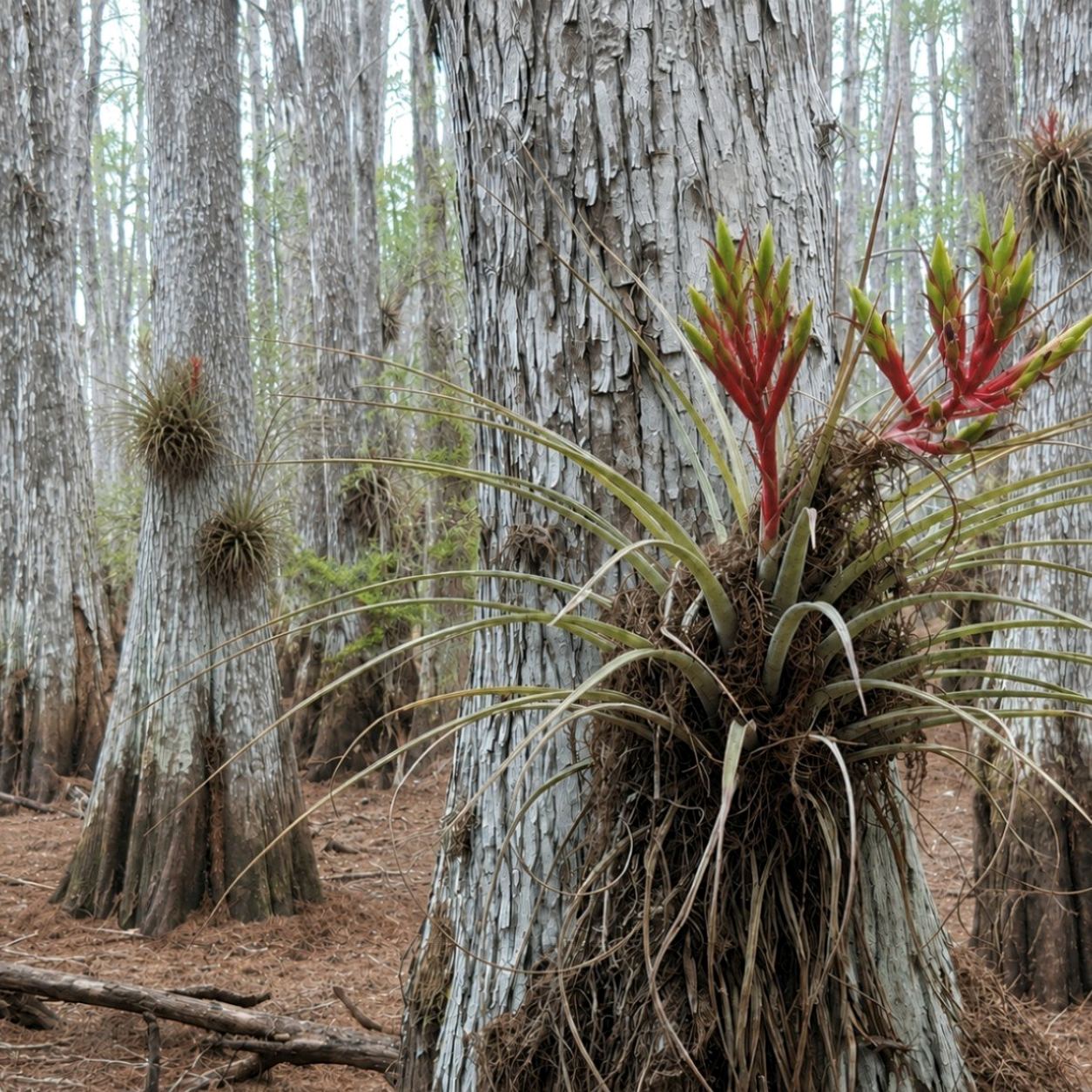
Native bromeliads are often called air plants because many grow as epiphytes on trees. They do not parasitize the host tree. Their roots primarily anchor them to bark and branches, while their leaves absorb moisture and nutrients from rain, air, and collected organic material.
Many bromeliads form overlapping leaf bases that collect rainwater. These small tanks become living habitats within the forest canopy.
Microorganisms and invertebrates can live in this collected water. Frogs and other animals may use the leaves for shelter, moisture, feeding, or refuge during dry periods. The plant becomes an ecological oasis above the forest floor.
When native bromeliads disappear, the impact can extend far beyond the plant itself. The tiny communities depending on the water, shade, organic matter, and shelter held within their leaves may disappear with them.
A native bromeliad is not merely an ornament hanging from a branch. It is a living reservoir and habitat within the forest canopy.
Some Native Species Are Especially Vulnerable
The giant air plant, Tillandsia utriculata, faces an especially serious threat. It can take years to reach reproductive maturity and generally relies heavily on seed production rather than repeatedly producing vegetative offsets. The Tillandsia utriculata can take up to 20 years to reach full flowering size!
When a weevil kills a giant air plant before flowering, that plant may leave no replacement generation behind.
Other large native bromeliads, including the cardinal air plant and several native Tillandsia species, are also vulnerable. Plants that were once conspicuous in Florida’s forest canopy have become uncommon or absent in some places where they previously grew.
The Weevil Is Not the Only Threat
Florida’s bromeliads also face habitat loss, illegal collection, poaching, altered forest conditions, climate stress, and removal by people who mistakenly believe air plants harm trees.
They do not harm their host trees. Removing them from the wild can eliminate mature individuals that took years to reach reproductive size.
- Development removes host trees and entire bromeliad habitats.
- Habitat fragmentation isolates surviving populations.
- Illegal collection removes mature seed-producing plants.
- Invasive pests kill plants before reproduction.
- Climate and hydrological changes can alter forest moisture and canopy conditions.
- Small populations become increasingly vulnerable to local extinction.
Why Controlling the Weevil Is Not Enough
Conservationists have investigated biological control, protective cages, monitoring, temporary captive protection, pesticide treatments, and other methods intended to reduce weevil damage.
Some conservation programs have protected important plants until they reached reproductive maturity and then returned them to wild habitat so they could release seed. These interventions are valuable, but they cannot protect every bromeliad growing across Florida.
The weevil is already established across a large area, and no single control method has eliminated it. Habitat destruction continues independently of the insect.
Florida therefore needs a strategy that protects both existing plants and their reproductive future.
Seed Preservation Creates Options
A responsibly collected and documented bromeliad seed lot may later support:
- Propagation for conservation collections.
- Restoration of depleted wild populations.
- Germination and establishment research.
- Study of regional genetic differences.
- Research into possible weevil tolerance.
- Reintroduction after habitat protection or pest management.
- Long-term protection against local extinction.
Every Seed Must Retain Its History
A bromeliad seed collection is most valuable when its origin is known. Seed without source information cannot fully represent the ecological or genetic history of the original population.
Responsible collections should document as much information as possible, including:
- Species identification.
- Collection date.
- County and general source region.
- Habitat type and host-tree species.
- Approximate population size.
- Number of parent plants represented.
- Evidence of weevil activity.
- Flowering and seed maturity.
- Landowner permission or required authorization.
- Processing, testing, and storage history.
This documentation allows future researchers and restoration partners to understand where the seed originated and how it relates to other populations.
Genetic Diversity Could Determine Which Plants Survive
Some bromeliad populations appear to persist or recover more successfully than others after weevil exposure. Researchers are examining whether these differences may have a genetic basis.
If certain populations carry traits associated with greater survival, those traits could become important to future conservation. However, relying on a single apparently resistant population would create a new risk.
Spreading one narrow genetic line statewide could reduce overall diversity and leave the species more vulnerable to a future disease, environmental shift, or invasive organism.
The goal should not be to preserve only one successful population. It should be to protect the broadest possible range of Florida’s remaining bromeliad genetics.
A Statewide Collection Must Be Regionally Diverse
Florida’s native bromeliads grow across different forests, wetlands, hydrological systems, and climate zones. Populations in South Florida may not be genetically identical to those in Central Florida, coastal hammocks, cypress systems, or other habitats.
A meaningful conservation collection should therefore represent multiple legally accessible populations across each species’ remaining range.
- Collect from numerous parent plants rather than one individual.
- Leave enough seed for natural reproduction and wildlife.
- Preserve distinctions among counties and ecological regions.
- Maintain separate and traceable seed lots.
- Prioritize populations facing immediate habitat loss.
- Coordinate with botanists, gardens, agencies, researchers, and landowners.
- Follow all laws governing protected plants and public or private land.
Seed Storage Is Only One Part of Preservation
Bromeliad seeds can be extremely light, delicate, and adapted for wind dispersal. Different species may respond differently to drying, temperature, humidity, storage duration, and germination conditions.
Some may not tolerate conventional long-term seed-bank storage. A serious conservation program should therefore combine multiple approaches.
- Seed collection and careful processing.
- Germination testing and viability monitoring.
- Living conservation collections.
- Nursery propagation.
- Genetic and genomic research.
- Host-tree establishment studies.
- Controlled reintroduction.
- Continued monitoring of restored populations.
When conventional storage is unsuitable, living collections and periodically regenerated conservation populations may be required.
What Floridians Can Do
Residents can help by protecting healthy bromeliads and reporting suspected weevil damage without disturbing the plants.
- Leave healthy native bromeliads attached to their host trees.
- Photograph suspected weevils or plant damage.
- Record the location without removing the plant.
- Report observations through appropriate conservation or citizen-science channels.
- Avoid purchasing wild-collected bromeliads.
- Buy nursery-propagated plants from reputable sources.
- Never collect protected plants or seed without permission.
- Protect bromeliad-bearing trees and surrounding habitat.
Why Florida Must Preserve Bromeliad Seed Now
A mature bromeliad killed before reproduction represents more than one dead plant. It represents the loss of future seeds, regional genetics, and the canopy habitat that plant would have continued to support.
When the same pattern repeats across thousands of plants, entire generations can disappear from Florida’s forests.
Seed collection gives conservationists time. It preserves material for research while scientists study possible resistance. It supports propagation while new control strategies are tested. It protects regional genetics while habitats are restored.
For Florida’s native bromeliads, seed preservation is not an optional final step. It is one of the most immediate tools available to prevent today’s losses from becoming permanent.
Protecting Florida’s Air Plants Before They Disappear
Florida’s bromeliads are living reservoirs in the forest canopy. They hold water, shelter wildlife, support specialized organisms, and contribute to the complexity that makes Florida’s ecosystems unique.
Their survival will require habitat protection, public education, pest monitoring, scientific research, living collections, responsible propagation, and coordinated control of invasive weevils.
It will also require seed.
By building a documented, regionally diverse collection of native bromeliad seed, Florida can preserve the biological options needed for future recovery even while some wild populations continue to decline.
Every seed collected responsibly is a safeguard against extinction and a promise that Florida’s air plants may one day return to the branches where they belong.