Florida is home to an extraordinary number of plants with remarkably small natural ranges, but few illustrate the importance of local plant conservation quite like the Punta Gorda spider lily, Hymenocallis puntagordensis.
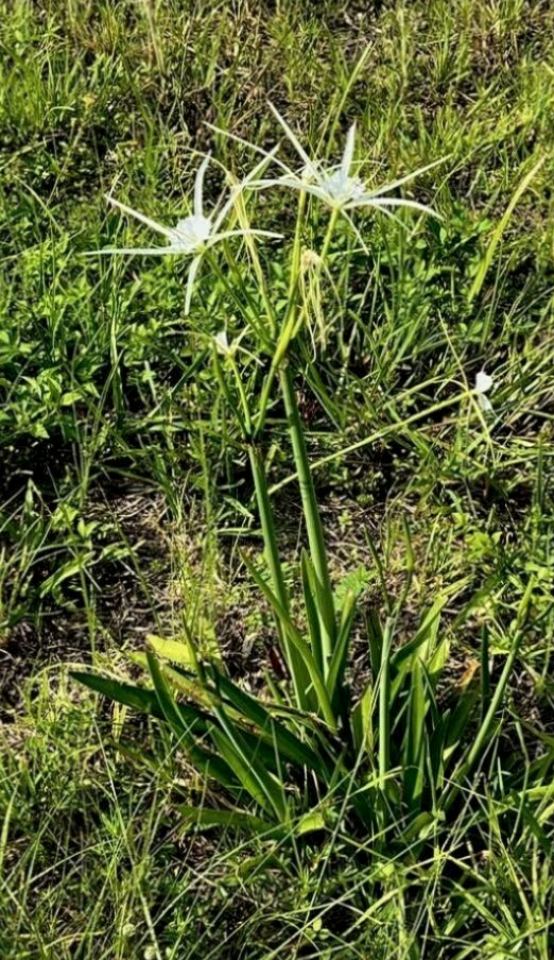
This rare Florida native is known naturally from Charlotte County in Southwest Florida and nowhere else in the world. Its entire known native range is concentrated around the Punta Gorda area, making the survival of the plant inseparable from the conservation of a very small piece of Florida.
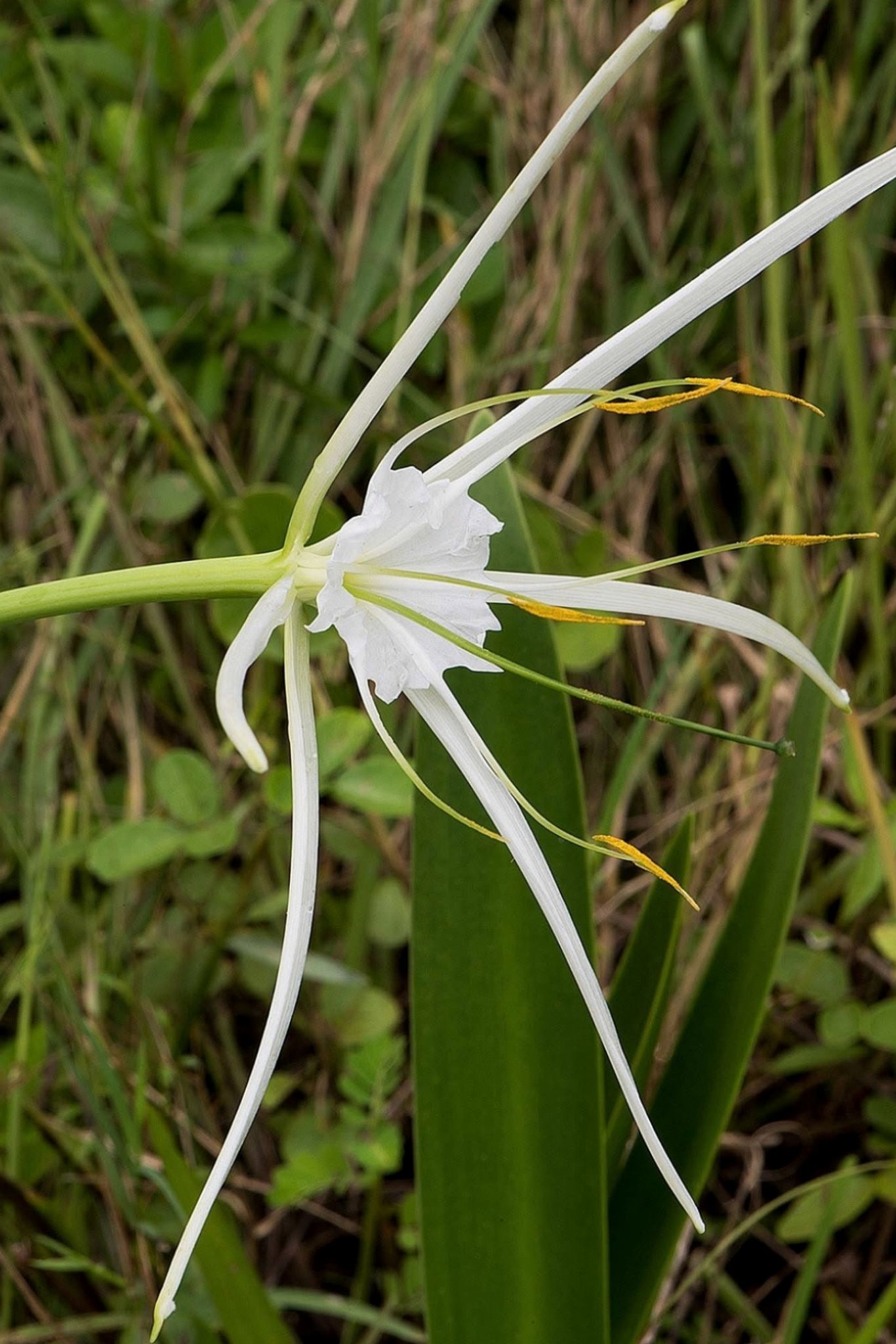
The Punta Gorda spider lily produces striking white flowers with long, narrow petals radiating outward around a central staminal cup. Like other members of Hymenocallis, the unusual flower shape gives it the appearance of a spider suspended above the surrounding vegetation.
Why This Plant Matters
- It is naturally restricted to Charlotte County, Florida.
- It is one of Florida’s most narrowly distributed endemic native plants.
- Its extremely small natural range makes individual populations especially important.
- Habitat loss or disturbance at only a few sites could affect a meaningful portion of the species’ remaining wild diversity.
- Conservation botanists consider the plant to be at serious risk even though it is not currently listed by the State of Florida as threatened or endangered.
Rare, but Not State-Listed
Despite its extraordinary rarity and extremely restricted range, the Punta Gorda spider lily is not currently listed by the State of Florida as threatened or endangered.
Florida botanist and author Roger L. Hammer has stated that the Punta Gorda spider lily should be considered threatened. That assessment reflects an important conservation reality: a plant can be highly vulnerable long before it receives a formal legal designation.
Other conservation assessments reinforce that concern. NatureServe considers the Punta Gorda spider lily Critically Imperiled, its highest category of conservation concern before a species is considered possibly extinct.
A species does not suddenly become vulnerable on the day it is formally listed. Conservation should begin before that point.
A Plant Tied to One Florida County
The Punta Gorda spider lily has historically been documented around roadsides, ditches, disturbed pine habitats, and other sites in the Punta Gorda area.
Unlike widespread Florida natives that may occur across dozens of counties, the loss of even a few Punta Gorda spider lily populations could represent a meaningful loss of the species’ remaining wild genetic diversity.
That makes Charlotte County more than simply part of its range. Charlotte County holds the world’s natural population of this Florida endemic.
Conservation Work Is Already Underway
Researchers and conservation organizations have devoted increasing attention to locating and protecting surviving populations of the Punta Gorda spider lily.
Naples Botanical Garden has worked with conservation partners to survey the species at the Fred C. Babcock/Cecil M. Webb Wildlife Management Area. During one major survey effort, conservationists mapped approximately 180 individual plants and collected seed for conservation.
The Garden has also established safeguarded collections of Punta Gorda spider lily seed, helping provide protection against the possibility that wild populations could someday be lost.
Why Seed Conservation Helps
- Seed collections can preserve genetic material from documented wild populations.
- Stored seed can support future research, propagation, restoration, and recovery work.
- Multiple collections can help represent genetic differences among surviving populations.
- Seed banking provides an additional safeguard against catastrophic habitat loss.
- Seed conservation complements, but does not replace, protection of wild habitat.
Why Such a Small Range Matters
Plants with extremely restricted distributions face risks that widespread species do not.
Development, changes in land management, altered hydrology, invasive species, hurricanes, roadside maintenance, habitat degradation, or the destruction of only a few sites can potentially affect a significant portion of their total population.
Florida’s continued growth makes conserving these narrowly endemic plants particularly important. Once a unique local population disappears, the genetic diversity contained within it cannot simply be recreated.
The Punta Gorda spider lily demonstrates why conservation cannot focus only on plants that have already received a legal designation as threatened or endangered.
Florida’s Native Spider Lilies Extend Far Beyond Punta Gorda
The Punta Gorda spider lily is only one member of a remarkable group of Hymenocallis native to Florida. A Florida Department of Agriculture and Consumer Services botanical review documented 13 native spider lily species in Florida, many of them associated with wetlands, floodplains, stream banks, marshes, wet prairies, and other habitats shaped by water and fire.
Several of Florida’s rarest native spider lilies occur in the Panhandle. They can be difficult to identify because some species differ only in subtle features of their leaves, bulbs, bracts, staminal cups, flowers, and habitat. Botanists studying Florida’s native Hymenocallis have emphasized that even flowering plants of several species can be challenging to distinguish, making precise location and habitat information especially useful.
Notable Native Panhandle Spider Lilies
- Florida Panhandle spider lily, Hymenocallis choctawensis: A native spider lily of floodplain swamps from the Apalachicola River westward across the Florida Panhandle. Its natural range also extends outside Florida, so it is a Florida native rather than a Florida endemic.
- Cow Creek spider lily, Hymenocallis franklinensis: A narrowly distributed Panhandle native associated with marshes and floodplain swamps along the lower Ochlockonee and Sopchoppy river systems. It was formally described from the lower central Florida Panhandle and is considered endemic to the lower Ochlockonee River drainage.
- Gholson’s spider lily, Hymenocallis gholsonii: An exceptionally rare Florida endemic known from Liberty County in the Apalachicola National Forest. It occurs in scattered populations along a stream and its branches and was formally described as a distinct species in 2009.
- Henry’s spider lily, Hymenocallis henryae: A rare Florida Panhandle endemic found in wet prairies, wet pine flatwoods, and around the edges of cypress domes. Florida botanical sources list it as endangered in the state, and recent genetic research has documented very small populations and low genetic diversity across much of its range.
- Godfrey’s spider lily, Hymenocallis godfreyi: A rare Florida endemic associated with coastal marsh habitat in Wakulla County, particularly around the St. Marks and Wakulla river systems. It is listed as endangered in Florida and is notable for flowering particularly well following fire.
- White-sands spider lily, Hymenocallis duvalensis: A Florida native of floodplain habitats occurring from northeast Florida westward into the Ochlockonee River drainage of the central Panhandle.
- Northern spider lily, Hymenocallis occidentalis: A Florida native occurring from Leon County westward in the Panhandle, often in upland hardwood forests rather than the wetter habitats associated with many other Florida spider lilies.
- Spring-run spider lily, Hymenocallis rotata: A Florida native found along spring runs and lakes from Wakulla County into the central peninsula.
Together, these species show how strongly Florida’s native spider lilies are tied to individual watersheds and natural communities. A species associated with a Wakulla County coastal marsh may face very different ecological conditions from one growing along a Liberty County stream, an Ochlockonee River floodplain, or a Charlotte County roadside ditch.
That geographic specialization matters for seed conservation. Preserving a species name alone is not enough. Whenever possible, seed collections should retain information about the exact population, watershed, habitat, county, collection date, and ecological conditions in which the parent plants were growing.
Another Rare Native Panhandle Bulb: The Panhandle Lily
Florida’s Panhandle also supports rare native bulbs outside the genus Hymenocallis. One of the most notable is the Panhandle lily, Lilium iridollae, a true lily in the family Liliaceae rather than an amaryllis-family spider lily.
The Panhandle lily is native to Northwest Florida and is associated with wet seepage habitats. Florida Natural Areas Inventory has conducted population surveys of the species in northwest Florida, where it is treated as a rare conservation species. Its presence alongside rare spider lilies reinforces just how much botanical diversity is concentrated in the Panhandle’s wet prairies, seepage systems, floodplains, flatwoods, and other moisture-dependent habitats.
Florida’s rare bulbs are not interchangeable. Many are tied to particular watersheds, soils, fire regimes, and hydrology, which makes preserving their local genetics as important as preserving the species themselves.
Protecting Florida’s Botanical Heritage
The Punta Gorda spider lily is part of Florida’s natural heritage in the most literal sense. It evolved as part of this landscape and survives naturally in an area measured not in states or countries, but essentially in one Florida county.
Protecting plants like this is one reason the Florida Seed Bank is being built.
Preserving responsibly collected, genetically diverse seed from Florida native plants can provide an additional layer of protection for species and populations facing habitat loss, extreme weather, development, and other environmental pressures.
Seed conservation cannot replace protecting wild habitat, but it can complement habitat conservation by safeguarding genetic material for future research, propagation, restoration, and recovery efforts.
Seed collection should always respect land ownership, protected species laws, permit requirements, and the health of the source population. Rare plants and small populations require careful conservation planning, documentation, and appropriate authorization.
The Punta Gorda spider lily reminds us that some of Florida’s botanical treasures may exist in only a handful of places.
They do not need to be federally endangered to be worth protecting. They do not need to disappear before we recognize their value.
And when a plant exists naturally in only one county on Earth, conserving what remains should be treated with the urgency that rarity deserves.
Sources and Further Reading
- Naples Botanical Garden: Punta Gorda Spider Lily Conservation
- NatureServe Explorer
- Roger L. Hammer, Florida botanist and author, on the conservation status of the Punta Gorda spider lily.
- Florida Department of Agriculture and Consumer Services: The Spider Lilies (Hymenocallis) Native to Florida
- U.S. Geological Survey: A New Species of Hymenocallis in the Florida Panhandle
- Smith & Garland: Hymenocallis gholsonii from the Apalachicola National Forest
- Genetic Variation Among Rare Florida Endemic Hymenocallis henryae Populations
- Florida Natural Areas Inventory: Rare Plant References and Panhandle Lily Surveys