1
Habitat Is Disappearing
Rapid development and land conversion continue to reduce and divide Florida’s remaining natural areas.
Conserving the genetic diversity of Florida’s native flora—and the ecological knowledge needed to restore functioning native ecosystems for generations to come.
Florida Seed Bank exists to conserve more than species names. Our mission is to preserve documented wild-origin native plant germplasm, population-level provenance, and the ecological context that gives those collections meaning so future conservationists have better tools for research, propagation, restoration, and species recovery.
Florida’s native plants have evolved within distinct soils, hydrology, fire regimes, wetlands, sandhills, scrub, pine flatwoods, prairies, coastal systems, and other ecological communities. Populations of the same species can carry different locally adapted genetics. When a wild population disappears, those regional genetic options may disappear with it.
That is why our work connects ethical field collection, accession-level provenance, long-term seed banking, living collections, in-vitro and tissue-culture conservation where appropriate, propagation research, geographically separated safety duplication, and practical ecological restoration.
We also document selected reference-site conditions—such as associated vegetation, habitat structure, hydrology, soil or substrate context, and other environmental observations—so conserved plant material is not separated from the ecology that shaped it.
Florida Seed Bank is a statewide native plant conservation initiative built around a long-term goal: document and conserve Florida’s native plant genetic diversity before irreplaceable wild populations and regional ecotypes disappear.
Florida is home to roughly 3,200 native plant species. Our mission includes the full native flora: common ecological foundation species, locally distinctive populations, declining species, endemics, threatened plants, and endangered plants.
A plant does not need to be endangered to have conservation value. A species that is common today may become scarce tomorrow because of development, altered hydrology, invasive species, changing fire regimes, severe storms, sea-level rise, habitat fragmentation, or other pressures.
Florida Seed Bank therefore works to preserve documented genetic material while healthy populations still exist, along with the geographic and ecological provenance needed to understand where that material came from and how it may responsibly support future conservation or restoration.
Our long-term objective is not simply to collect seeds. It is to build a genetic record of Florida’s native flora.
Florida Seed Bank is building a statewide conservation system that preserves documented native seed and other plant germplasm together with provenance and selected ecological-reference information needed for future research, propagation, restoration, and species recovery.
Each accession is tied to its biological and geographic context. Species identity, source population, location, habitat, collection date, and regional provenance are preserved with the material so future users know not only what was conserved, but where it came from.
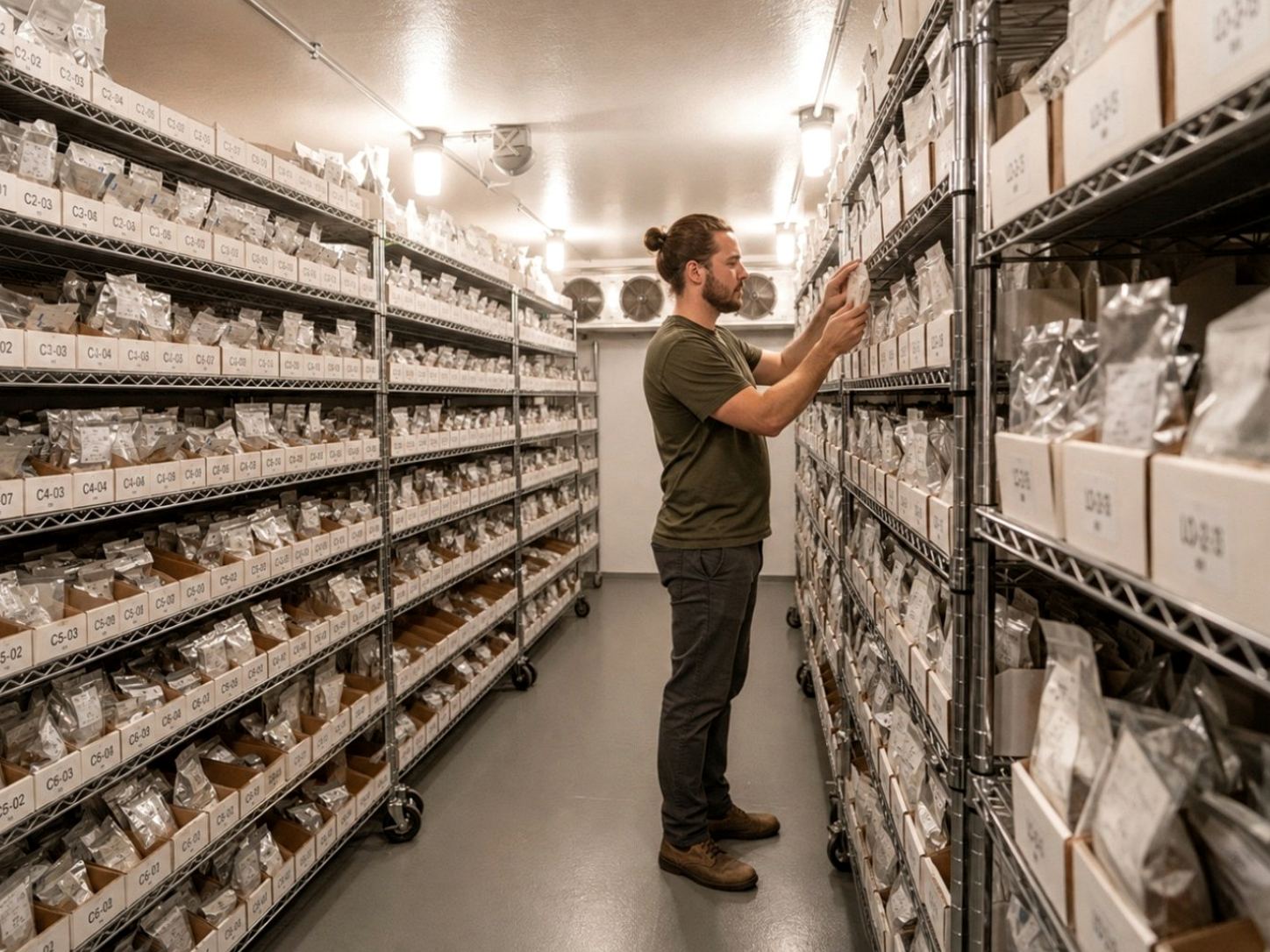
For species suitable for conventional seed banking, properly cleaned and dried seed is sealed in moisture-resistant archival packaging and maintained in approximately −20 °C long-term storage. Geographic duplicate collections, monitoring, backup power, viability testing, and periodic regeneration help protect the collection over time.
Species that do not tolerate conventional drying or freezer storage require different conservation methods. Living collections, propagation, in-vitro and tissue-culture approaches, pollen or cryogenic conservation through qualified partners where appropriate, and other species-specific methods remain part of the same germplasm-conservation mission.
Florida Seed Bank does not wait for a native plant to become endangered before preserving its genetics. A species may still be considered common statewide while individual populations—and the locally adapted genetics they contain— disappear one site at a time.
Our mission therefore extends across Florida’s roughly 3,200 native plant species. Common ecological foundation species, regional populations, declining plants, endemics, threatened species, and endangered species all contribute to Florida’s genetic and ecological diversity.
Preserving a species is important. Preserving the geographic diversity within that species is what keeps future restoration options open.
We should not have to know exactly why a native plant population will be valuable in the future before deciding that it is worth preserving today.
Plants from different populations can carry different combinations of traits shaped by geography and local environmental conditions. As global warming and broader climate change alter Florida’s temperatures, rainfall patterns, drought stress, coastal conditions, fire regimes, storm impacts, pests, and diseases, genetic diversity may give future conservation and restoration work more options for responding to conditions we cannot fully predict today.
This is why Florida Seed Bank preserves more than species names. Documented population-level collections retain biological options for future research, propagation, restoration, species recovery, and adaptation planning. Once a local population disappears, its exact genetic history may be impossible to recreate.
County-level origin is useful, but it is not always enough. Where appropriate, Florida Seed Bank records accession data at the population and site level, including habitat, ecoregion, soil or hydrologic context, collection date, source population, and geographic coordinates.
Exact coordinates for rare, sensitive, or vulnerable populations are protected from public disclosure when revealing them could increase collecting pressure, trespass, vandalism, or other risk. The scientific provenance remains preserved internally even when the public-facing record is intentionally generalized.
This allows the repository to function not simply as a species list, but as a geographic genetic record of Florida’s native flora.
A conservation accession becomes more useful when future researchers understand the environment in which the source population was growing. For selected projects, Florida Seed Bank documents ecological reference information such as associated native vegetation, habitat structure, hydrology or moisture conditions, soil or substrate context, management history when known, and photographic site records.
Where scientifically justified and legally authorized, limited soil or substrate reference samples may also support future study. These samples are treated as ecological reference material—not as proof of everything that historically grew at a site—and are interpreted together with vegetation records, field observations, and other evidence.
This approach is especially valuable for restoration questions involving complex biological relationships, including native terrestrial orchids and their dependence on suitable site conditions and fungal partners.
Our long-term goal is not only to preserve material in storage. We want to learn how documented native germplasm can responsibly help rebuild functioning ecological communities.
The Central Florida Sandhill Conservation Pilot develops the collection, provenance, preservation, propagation, and seed-increase side of that model. Future small-scope restoration projects—including planned work with native terrestrial orchids in suitable managed roadside wetland and no-mow habitats—can help test how ecological components are re-established, monitored, and improved in the field.
By learning at a manageable scale, Florida Seed Bank can build practical knowledge for larger restoration projects where an ecological system must be reconstructed, replicated, or repaired.
A secure and genetically diverse supply of native seeds is essential for restoring Florida’s damaged landscapes.
Rapid development and land conversion continue to reduce and divide Florida’s remaining natural areas.
Native plant communities provide food and shelter for pollinators, birds, mammals, and countless other species.
Seeds collected from diverse, resilient populations help restored landscapes withstand disease, heat, drought, and changing environmental conditions.
Without dependable access to locally appropriate native seeds, even well-funded conservation projects can struggle to rebuild functioning ecosystems.
Our work connects wild-population provenance, responsible collection, species-appropriate germplasm conservation, ecological-reference data, restoration-scale propagation, geographic safety duplication, research, and practical ecosystem restoration.
We document native seed by species, source population, geography, habitat, collection date, and other useful ecological information so Florida’s regional plant genetics remain scientifically meaningful.
We cultivate regionally appropriate native wildflowers, grasses, and other restoration species to multiply seed yields while reducing repeated collection pressure on wild populations.
On private land facing clearing or permanent disturbance, Florida Seed Bank can evaluate legally authorized opportunities to document populations and preserve native seed before those local genetics disappear.
Long-term seed storage, viability testing, living collections, in-vitro and tissue-culture work where appropriate, ecological-reference records, geographic safety duplication, research collaboration, and restoration monitoring turn individual accessions into durable conservation infrastructure.
Our long-term vision is to preserve seeds representing native plant species from every region of Florida—from pine flatwoods and sandhills to prairies, wetlands, scrub communities, hardwood hammocks, and coastal ecosystems.
For native species whose seeds can safely tolerate drying and freezing, long-term conservation will require dedicated seed-bank freezers, moisture-resistant packaging, temperature monitoring, backup power, and careful viability testing. These systems are essential for maintaining seed quality over decades and protecting irreplaceable genetic material from equipment failure, storms, power loss, and other emergencies.
Some Florida native species cannot be preserved through conventional freezer storage and require alternative methods such as living collections, propagation, in-vitro or tissue-culture conservation, or other specialized protocols. Florida Seed Bank therefore builds conservation capacity across cold storage, viability monitoring, propagation, ecological reference documentation, geographically separated safety duplication, research, and species-appropriate preservation.
These preserved seeds are more than a collection. They are a biological insurance policy that can support research, propagation, habitat recovery, and future restoration efforts throughout the state before vulnerable wild populations are lost.
“Restoring Florida’s wild landscapes is not just about planting for today. It is about banking genetic resilience for tomorrow.”
Our public Standard Operating Procedure explains the principles behind Florida Seed Bank’s collection, provenance, conservation, research, propagation, safety duplication, and restoration work while intentionally protecting sensitive population locations and internal operating details.
Download Public SOP (PDF)
Florida’s native habitats are changing quickly, but there is still time to preserve wild genetic diversity, document ecological context, build restoration knowledge, and protect the biological options future generations may need.
Get Involved