Florida’s wild orchids are easy to think of as rare botanical treasures—beautiful plants hidden in swamps, hammocks, flatwoods, prairies, wetlands, and forests. But orchids can also tell us something much larger about the health of an ecosystem.
The Chicago Botanic Garden has warned that more than half of the world’s orchid species could disappear within this century as climate change, habitat loss, invasive species, and poaching take their toll. Its researchers describe wild orchids as especially sensitive because many depend on precise relationships among fungi, pollinators, and environmental conditions. When those relationships begin to fail, orchids can disappear early.
Florida has much to lose.
UF/IFAS reports that Florida is home to more than 100 native orchid species. A large share of that diversity is already listed as endangered or threatened in the state.
The problem is not one threat.
It is many threats arriving at once.
Four native orchids are documented as extirpated—locally extinct in Florida: Brassia caudata, Bulbophyllum pachyrrachis, Epidendrum acunae, and Macradenia lutescens. A fifth orchid, Govenia floridana, is considered globally extinct.
Florida Has Already Lost Native Orchids to Extinction
For Florida, orchid extinction is not a hypothetical future.
It has already happened.
At least five native orchid species have been lost from Florida’s wild flora. Four are officially documented as extirpated—locally extinct in Florida—and one, the Florida Govenia, is considered globally extinct.
These are not predictions or theoretical conservation scenarios. They are plants that once grew wild in Florida and no longer do.
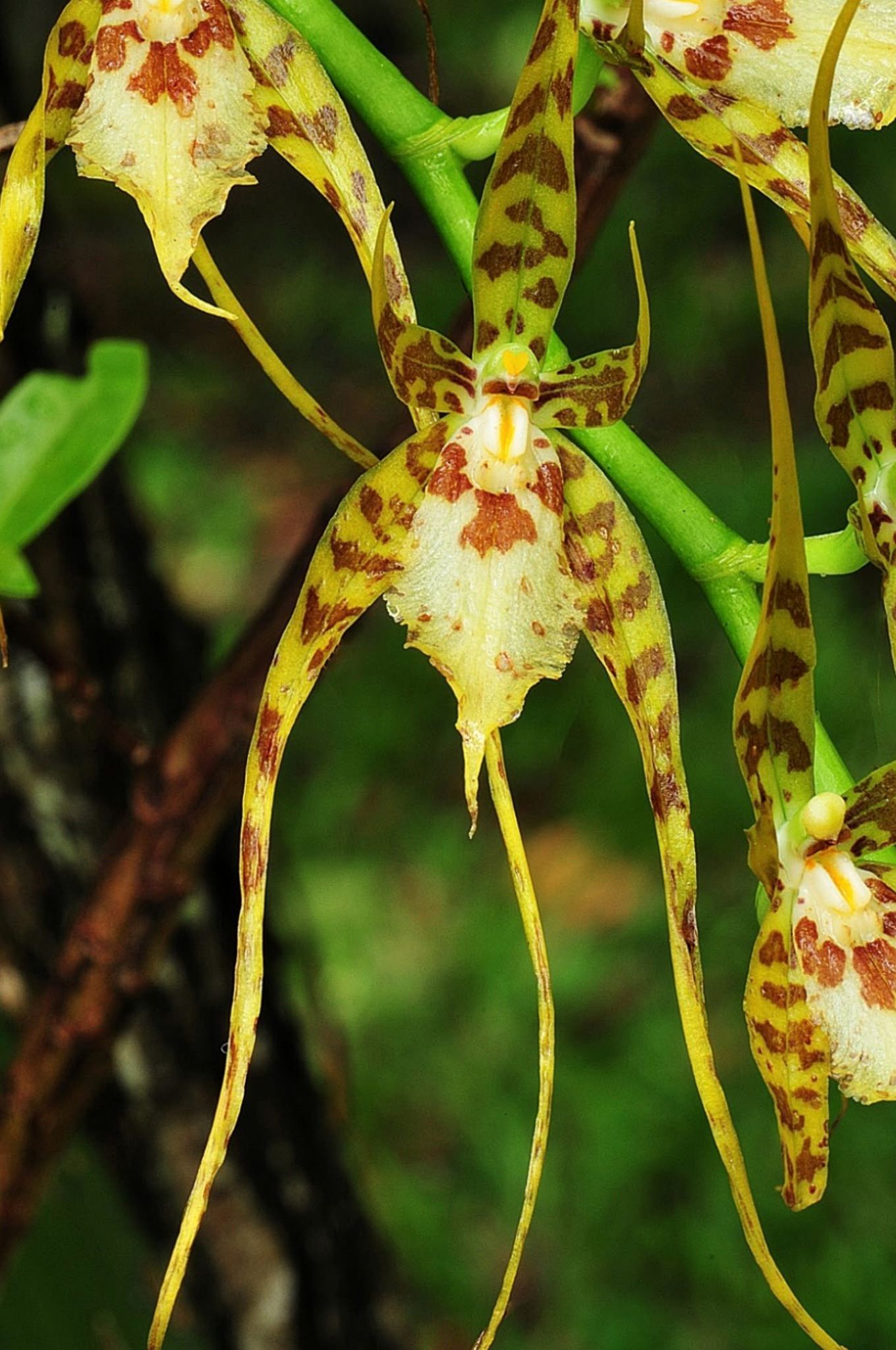
Spider Orchid — Brassia caudata
Extirpated from FloridaThe Spider Orchid once grew naturally in South Florida’s tropical hammocks. Its long, narrow, greenish-yellow floral segments gave the species its spider-like appearance. But hurricanes, habitat destruction, urban development, severe freezes, and relentless illegal collecting steadily reduced its Florida populations.
Naples Zoo’s South Florida orchid conservation program identifies Brassia caudata as one of four native orchids whose Florida populations were eventually declared extirpated by the Florida Natural Areas Inventory by the 1980s.
One surviving historical photograph captures how quickly a local loss can happen. Roger Hammer photographed a flowering Brassia caudata at Deer Hammock in Everglades National Park in April 1976. He later reported that the plant was killed only nine months later during the January 19–20, 1977 freeze, when snow was recorded in Miami.
The orchid still exists elsewhere in its broader range.
But the Florida population is extinct.
That distinction is crucial. When a population disappears from Florida, the state does not simply lose another place where the same plant happened to grow. It can lose genetic variation shaped by Florida’s climate, hydrology, soils, fungal communities, pollinators, storms, freezes, and other ecological pressures.
Those Florida genetics may be impossible to replace.
Rat Tail Orchid — Bulbophyllum pachyrrachis
Extirpated from FloridaThe Rat Tail Orchid is an extraordinary epiphytic species that produces elongated, hanging flower structures bearing numerous tiny blossoms.
It once occurred naturally in the Fakahatchee Strand of Southwest Florida.
Today it is extirpated from Florida.
Friends of Fakahatchee describes the Rat Tail Orchid as having been wiped out of the preserve—and therefore Florida—by collectors. Its closest surviving wild populations occur in western Cuba.
Naples Zoo likewise identifies it among the four South Florida orchids whose populations were declared extirpated by the Florida Natural Areas Inventory by the 1980s.
Researchers have traveled to Cuba specifically because the wild Florida population no longer exists.
That is what extinction at the population level looks like: conservationists searching another country for surviving relatives of a plant that Florida once possessed naturally.
Acuña’s Star Orchid — Epidendrum acunae
Extirpated from FloridaAcuña’s Star Orchid was another member of South Florida’s tropical orchid flora. It once occurred naturally in the Fakahatchee Strand.
It is now extirpated from Florida.
Friends of Fakahatchee identifies Epidendrum acunae as one of the preserve’s “lost orchids” and says it was extirpated from the preserve—and therefore Florida—by collectors.
Naples Zoo also lists Acuña’s Star Orchid among the four species whose South Florida populations were declared extirpated by the Florida Natural Areas Inventory by the 1980s after decades of hurricanes, development, and illegal poaching.
Again, surviving plants elsewhere do not restore what Florida lost.
The Florida population had its own ecological and genetic history. Once that population disappeared, that history disappeared with it unless conservation material had already been preserved.
Trinidad Macradenia — Macradenia lutescens
Extirpated from FloridaThe Trinidad Macradenia is a small epiphytic orchid with delicate hanging flowers. It too disappeared from Florida’s wild orchid flora.
Naples Zoo identifies Macradenia lutescens alongside the Spider Orchid, Rat Tail Orchid, and Acuña’s Star Orchid as locally extinct in Florida by the 1980s.
The Atlanta Botanical Garden likewise describes four “lost orchids” of South Florida whose populations were eliminated after decades of hurricanes, urban development, habitat loss, and illegal plant collecting.
Their disappearance is an important lesson.
Local extinction does not necessarily arrive in a dramatic final moment. A population can simply become smaller. Then rarer. Then increasingly difficult to locate. And eventually no one finds it again.
Florida Govenia — Govenia floridana
Presumed Globally Extinct — GXThe story of Florida Govenia may be the most sobering of all.
Unlike the four species above, which survived outside Florida after their Florida populations disappeared, Govenia floridana is considered extinct as a species.
NatureServe Explorer assigns Florida Govenia a global conservation status of GX—presumed extinct.
There is nowhere else to go looking for a surviving natural population.
The species was known only from a small area of tropical hardwood hammock on Long Pine Key in the Everglades. Scientists last verified Florida Govenia in 1964.
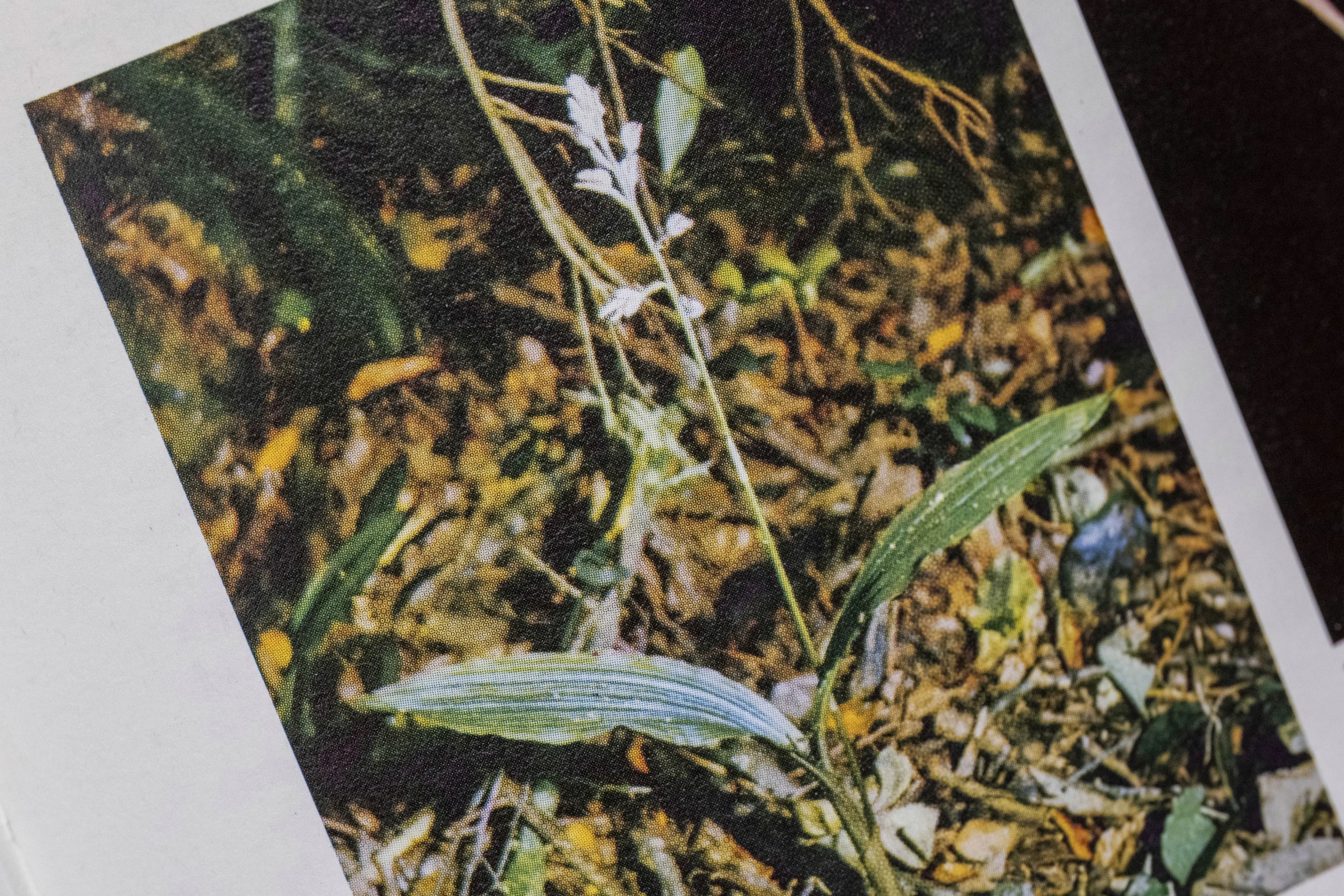
Kew Royal Botanic Gardens reconstructed the species’ history while evaluating its extinction. The story is especially painful because the orchid lived inside Everglades National Park.
Protection on a map did not save it.
Much of South Florida’s original habitat had already disappeared, and the orchid’s only known population was relatively accessible. Roads inside the Everglades made previously isolated hammocks easier to reach.
Once collectors learned where the newly discovered rare plant grew, individual plants began disappearing from the site.
Kew concludes that poaching was probably a major factor in its extinction, compounded by the extensive habitat loss already experienced across South Florida.
Today, no living conservation population is known.
No seed bank accession waits in a freezer.
No tissue-culture collection preserves it for reintroduction.
What remains are scientific records, herbarium specimens, and a tiny photographic record.
Florida Govenia is gone. That is the outcome modern plant conservation is supposed to prevent.
Florida’s “Lost Orchids” Are a Warning
The phrase “lost orchids” is not poetic exaggeration. Conservation organizations actually use it to describe orchids that historically belonged to Florida’s native flora but have disappeared from the state.
Researchers with the Atlanta Botanical Garden and Florida conservation partners have traveled to Cuba because some of the closest surviving wild populations of Florida’s extirpated orchids still grow there.
Those populations provide scientists with opportunities to study the species, propagate them, and explore whether restoration to Florida might someday be possible.
That work is extraordinary.
But it also exposes a painful reality:
Florida once had the populations researchers are now traveling internationally to find.
Had genetically representative material from those Florida populations been collected and responsibly preserved before they disappeared, conservationists might have much more to work with today.
That is why Florida Seed Bank’s approach emphasizes conservation before crisis.
Habitat Can Disappear Before a Species Does
Extinction does not begin when the last plant dies.
It begins population by population.
A species may still appear secure across a broad geographic range while individual populations quietly disappear beneath housing developments, commercial construction, roads, drainage projects, agriculture, utility corridors, or other land conversion.
That distinction matters because populations are not necessarily genetically interchangeable.
A native orchid growing in one part of Florida may have spent generations responding to a particular combination of rainfall, temperature, hydrology, soils, fungal communities, pollinators, fire regimes, and seasonal conditions.
A population 150 miles away may carry a different genetic history.
If the first population disappears beneath development, Florida has not merely lost a few plants. It may have lost a locally adapted piece of the species’ genetic diversity that cannot simply be recreated by moving plants from somewhere else.
This is why conservation cannot begin only after a species reaches the edge of extinction.
Florida Seed Bank believes we also need to preserve healthy wild populations before they become rare.
Overdevelopment Is a Biodiversity Problem
Florida’s continuing growth places enormous pressure on natural land.
Habitat loss and degradation are among the largest threats to native biodiversity, with land conversion for residential development, infrastructure, agriculture, and other uses among the causes. Non-native species and changing climate conditions compound that pressure.
For orchids, fragmentation can be especially damaging.
A development does not have to bulldoze the exact spot where an orchid grows to affect it.
A new road can change drainage.
A canal can lower the water table.
Nearby development can alter fire behavior.
Clearing can change humidity, shade, and wind exposure.
Fragmentation can separate plants from pollinators or reduce the continuity of fungal communities.
The ghost orchid provides an extreme example. Florida research describes how roads and canals fragmented South Florida swamp systems, altered natural water movement, lowered water tables, and changed the ecological conditions upon which the orchid depends.
For a plant whose survival depends on a narrow ecological window, a seemingly modest change in the landscape can have an enormous biological effect.
Before Miami Was Concrete, It Was an Orchid Forest
It is difficult to imagine today, standing among the towers of Downtown Miami and Brickell, but the landscape beneath the city was once dramatically different.
Before streets, rail lines, hotels, office towers, and high-rise condominiums transformed the shoreline of Biscayne Bay, much of this part of Miami was covered by the Brickell Hammock, a dense tropical hardwood forest growing along the Miami Rock Ridge.
Tropical hardwood hammocks are unlike almost any other forest in the continental United States. Their canopy can include live oak, gumbo-limbo, strangler fig, pigeon plum, wild mastic, paradise tree, and other tropical species, while the humid forest interior supports ferns, bromeliads, air plants, and orchids.
And orchids were part of that landscape.
Imagine Miami before Miami.
Instead of glass towers rising over Brickell Avenue, there would have been a shaded tropical forest. Tree trunks and limbs would have supported epiphytic plants. Native butterfly orchids such as Encyclia tampensis would have grown from bark and branches, while other native orchids occupied the surrounding hammocks, wetlands, pinelands, and coastal habitats.
The city we know today was built on top of one of Florida’s richest subtropical botanical landscapes.
The Forest Became the City
The arrival of railroads and rapid development at the end of the nineteenth century accelerated Miami’s transformation.
As the settlement expanded, tropical hardwood hammock was cleared for streets, buildings, agriculture, transportation infrastructure, and later increasingly dense urban development.
The loss was not limited to trees.
When a mature hammock disappears, everything living on those trees and beneath their canopy can disappear with it.
What Disappears When a Hammock Is Cleared
- Native orchids growing on trunks, limbs, and forest-floor substrates.
- Bromeliads and other epiphytes.
- Ferns and understory plants.
- Mycorrhizal fungi and other soil organisms.
- Pollinators and other associated wildlife.
- Seedlings and future generations of locally adapted plants.
- Population-level genetics that may have developed over many generations.
Miami-Dade County estimates that the region’s pine rocklands and tropical hardwood hammocks once covered approximately 180,000 acres. Today, only about 3,000 acres remain, with development and agriculture responsible for much of that decline.
That represents a loss of more than 98 percent of those historic natural forest communities.
A Tiny Piece of Old Miami Still Survives
Remarkably, a fragment of that original landscape still survives almost in the shadow of Brickell’s skyscrapers.
Simpson Park Hammock protects approximately 7.8 acres of tropical hardwood hammock in Miami’s urban core.
The City of Miami describes it as one of the last remnants of the historic Brickell Hammock. Concerned residents began fighting to preserve the property as early as 1913, and naturalist Charles Torrey Simpson helped persuade officials to protect part of the forest for future generations.
Walking through Simpson Park today gives visitors a glimpse of the landscape that existed before modern Miami.
The city sounds are still nearby.
Skyscrapers rise just beyond the trees.
But inside the hammock, the temperature drops, the canopy closes, and tropical vegetation surrounds the trail.
It is a surviving fragment of an ecosystem that once occupied vastly more land.
The Orchids Did Not Receive the Same Protection
Preserving a few acres of hammock cannot recreate everything that was lost.
Orchid populations can disappear through habitat clearing, altered hydrology, storms, freezing events, collecting, and the gradual ecological changes that occur when a large continuous forest becomes a tiny urban island.
Even when the trees survive, the biological relationships that once supported an orchid population may not.
The correct fungus may disappear.
A pollinator may become uncommon.
Humidity may change.
Surrounding forest may vanish.
Genetic exchange between populations may stop.
This is why preserving a remnant forest and preserving its complete biological history are not necessarily the same thing.
Miami Is a Warning Written in Concrete
Modern Miami is one of America’s great cities.
But underneath it is another history.
A tropical forest once occupied land now worth billions of dollars.
Native plants that would today be considered extraordinary grew where highways, hotels, condominiums, financial offices, and neighborhoods now stand.
There was no seed bank preserving every population before the land was cleared.
There were no ecological reference records documenting every hammock before development.
There were no geographically separated conservation collections protecting representative genetics from each disappearing population.
Much of that biological information simply vanished.
That is precisely why conservation has to happen before development reaches the last fragment and before a once-common plant becomes rare.
We cannot rebuild nineteenth-century Miami.
But we can learn from what happened there.
And we can decide that the native plant populations still surviving elsewhere in Florida should not have the same ending.
Even Protected Land Cannot Simply Be Taken for Granted
National parks and other public conservation lands are among the strongest protections remaining for intact ecosystems.
But “protected” does not mean immune from political, development, infrastructure, or privatization pressure.
On August 28, 2026, The Guardian reported that National Park Service staff had been exploring a proposal involving a quarter-mile parcel inside Yosemite National Park that a private developer sought in connection with private road access to property outside the park.
The reporting described a proposal under consideration—not a completed land transfer.
Yosemite is far from Florida, but the conservation lesson is relevant everywhere.
Protected landscapes should never be viewed as biologically invulnerable simply because a boundary has been drawn around them.
Road access, land exchanges, utility corridors, adjacent development, altered water management, changing management policies, and other pressures can fragment habitat or change ecological conditions even when most of a protected landscape remains intact.
For rare plants—and especially plants with highly specialized ecological relationships—the difference between an intact habitat and a fragmented one can determine whether a population persists.
Conservation therefore needs another layer of protection: preserving the genetic material of wild populations outside the landscape as well as within it.
Orchids Cannot Be Saved Like Ordinary Garden Plants
Wild orchid conservation is unusually difficult because an orchid is not biologically independent.
Orchid seeds are extraordinarily small and contain little of the stored energy found in many other seeds.
Many species depend upon particular mycorrhizal fungi during germination and development.
The Chicago Botanic Garden describes conservation work in which orchid seeds are paired with fungal partners, germinated under sterile laboratory conditions, grown through tissue culture, moved into greenhouse conditions, hardened off, and eventually prepared for reintroduction.
That process can take years.
And producing a flowering orchid in a laboratory does not necessarily mean a wild population has been restored.
A functioning population must eventually survive, flower, reproduce, produce viable seed, recruit new plants, and continue doing so without perpetual human intervention.
That requires conserving much more than the orchid.
An Orchid May Depend On
- Specific mycorrhizal fungi needed for germination or development.
- Pollinators capable of moving pollen between suitable plants.
- Host trees or surrounding native vegetation.
- Appropriate hydrology and seasonal moisture conditions.
- Suitable substrate, soil chemistry, or organic matter.
- Correct canopy cover, humidity, and light conditions.
- Fire, flooding, or other natural disturbance regimes.
- Enough genetic diversity for the population to adapt over time.
This is why an orchid can be a powerful indicator of ecosystem health.
When the orchid disappears, the problem may be much larger than the loss of one flower.
Poaching Can Push Small Populations Even Closer to the Edge
Orchids have another enemy: their own beauty.
Wild orchids have been collected for generations, and some Florida species have been harvested so heavily that populations were devastated.
South Florida was once extraordinarily rich in wild orchids, but commercial exploitation and collecting drove some populations toward near extinction.
The U.S. Fish and Wildlife Service has identified poaching as a principal threat to Florida’s ghost orchid, along with wetland loss and habitat degradation.
When proposing federal protection for the species, the agency also declined to propose critical habitat because publicly identifying sensitive areas could increase poaching risk.
Scientific records should document where conservation material originated. Exact coordinates for vulnerable populations may need to remain restricted when disclosure could increase collection pressure or disturbance.
A population cannot be conserved if publicity helps someone remove it from the wild.
Invasive Species Add Another Layer of Pressure
Florida’s native ecosystems are also being transformed by introduced plants and animals.
Invasive plants can change vegetation structure, compete for light and nutrients, alter fire behavior, and disrupt the ecological communities on which orchids depend.
Some invasive orchids have themselves become established in Florida.
Orchid conservation therefore cannot focus exclusively on the target orchid.
It must ask what else is happening in the surrounding plant community.
Climate Change Multiplies Existing Threats
Climate change rarely acts alone.
It magnifies existing vulnerabilities.
Sea-level rise can push saltwater farther into coastal systems.
Changing rainfall can alter wetland hydroperiods.
Drought can increase fire risk.
Stronger storms can damage host trees and alter forest structure.
Warmer conditions may change flowering times, fungal activity, pollinator relationships, and the suitability of existing habitat.
A large, genetically diverse population has more biological options for responding to change.
A tiny, isolated population has fewer.
That makes genetic conservation increasingly important.
Saving a Species Name Is Not Enough
Traditional conservation discussions often begin with a question:
Is this species endangered?
Florida Seed Bank is interested in another question:
What genetic diversity are we losing before a species ever reaches that list?
Two populations may carry different adaptations.
Different maternal lines within the same population may represent additional genetic variation.
A seed collection with no reliable location, habitat, population, or collection history preserves only part of the biological information.
A conservation accession should therefore preserve not only the seed, but its provenance.
That can include species identity, source population, collection date, habitat, environmental conditions, associated plant community, maternal line information where appropriate, processing history, viability, propagation history, and eventual restoration use.
The goal is not to build a freezer filled with anonymous packets.
It is to build a genetic library of Florida’s native flora.
Some Orchids May Never Belong in a Conventional Seed Freezer
Seed banking is enormously valuable, but not every species behaves the same way.
Some seeds tolerate drying and long-term cold storage.
Others do not.
Orchid conservation may involve conventional seed storage where scientifically appropriate, but it can also require in-vitro culture, tissue culture, living collections, pollen conservation, fungal conservation, or cryogenic approaches.
Botanical institutions are already developing practical frameworks for growing genetically diverse orchids and returning them to threatened habitats.
The conservation method should follow the biology of the species—not force every species into the same storage method.
We Need to Preserve the Ecosystem Around the Seed
This is also why Florida Seed Bank is interested in recording ecological information alongside plant collections.
When appropriate, a conservation record can document more than where an orchid was found.
It can capture the surrounding native vegetation, hydrology, substrate, light conditions, habitat structure, disturbance history, photographs, associated species, and other characteristics of the source community.
Those records matter because future restoration may need to answer questions that cannot be answered by a seed packet alone.
Questions Future Restoration May Need to Answer
- What native plants grew beside the orchid?
- How wet was the site and how did moisture change seasonally?
- Was the habitat seasonally flooded?
- Which host trees or shrubs were present?
- Was the canopy open, filtered, or closed?
- What native groundcover surrounded the population?
- What fungi were associated with the roots or substrate?
- What management or natural disturbance kept the habitat functioning?
A century from now, those ecological records could be almost as valuable as the conserved genetic material itself.
From Orchid Conservation to Ecological Reconstruction
The ultimate goal should not be simply to grow orchids in laboratories.
It should be to create conditions in which wild populations can sustain themselves again.
That means restoration eventually has to move beyond individual plants toward ecological reconstruction.
An orchid restoration site may need appropriate native vegetation, hydrology, substrate, fungal communities, pollinators, light conditions, and long-term land management.
Success should not be measured solely by how many plants are installed.
It should be measured by whether they survive.
Whether they flower.
Whether they reproduce.
Whether seedlings recruit.
Whether the associated ecological community functions.
And ultimately, whether humans can reduce their intervention because the system begins sustaining itself.
Extinction Changes the Question
Once we acknowledge these losses, the question facing Florida plant conservation changes.
It is no longer:
Could Florida lose native orchids?
We already have.
The question is:
Which population will disappear next, and will anything have been conserved before it happens?
The Spider Orchid is extinct in the Florida wild.
The Rat Tail Orchid is extinct in the Florida wild.
Acuña’s Star Orchid is extinct in the Florida wild.
The Trinidad Macradenia is extinct in the Florida wild.
And Florida Govenia is extinct everywhere.
Those are five warnings written into Florida’s botanical history.
Florida Still Has Time to Save What Remains
There is a tendency to think of conservation as something that begins when a species reaches the brink.
By then, much of the opportunity may already be gone.
Once a population consists of only a handful of plants, conserving its genetic diversity becomes harder.
Once a habitat has been developed, its hydrology and ecological relationships may be impossible to reconstruct exactly.
Once local populations disappear, their unique genetic history may disappear with them.
Florida still has extraordinary native plant diversity.
It still has orchids growing in swamps, hammocks, forests, prairies, wetlands, flatwoods, and even roadside habitats.
Some are already endangered.
Others remain locally abundant.
Both matter.
The same forces threatening orchids worldwide—climate change, habitat destruction, invasive species, and poaching—are operating here, alongside Florida’s extraordinary development pressure and increasing uncertainty about whether even protected landscapes can always remain untouched.
The question is whether we preserve enough of Florida’s biological inheritance while we still have the opportunity.
A seed bank cannot stop every development.
It cannot stop every hurricane.
It cannot remove every invasive species.
It cannot guarantee that land considered protected today will remain unchanged forever.
But it can help ensure that when a wild population is damaged or lost, its genetics, its history, and our knowledge of the ecosystem it belonged to do not necessarily disappear with it.
We need to preserve Florida’s wild plant genetics while they are still wild.
Building a Florida Native Orchid Collection Responsibly
One way people can develop a deeper appreciation for Florida’s orchid diversity is by building a legally and ethically sourced cultivated collection. A private conservation-minded collection should never be built by removing plants from the wild. Plants should come from reputable nurseries, established cultivated divisions, documented propagation programs, seed-grown material, or other lawful sources.
Availability changes over time, and some Florida-native orchids are much easier to locate in cultivation than others. The following species can provide a useful starting point for someone interested in learning the diversity of Florida’s native orchid flora while supporting responsible propagation rather than wild collection.
Many Florida orchids are endangered, threatened, locally extirpated, or otherwise protected. Even when a species survives elsewhere, Florida populations may carry unique regional genetics. Purchase or obtain cultivated material only from legal, reputable sources, and keep provenance information whenever it is available.
Florida Native Orchids That Can Form a Strong Cultivated “Backbone”
- Encyclia tampensis
- Encyclia boothiana
- Epidendrum magnoliae (formerly commonly referred to as E. conopseum)
- Epidendrum magnoliae var. magnoliae — associated with more northern portions of its Florida range
- Epidendrum magnoliae var. mexicanum — associated with more southern portions of its Florida range
- Epidendrum nocturnum
- Prosthechea pygmaea
- Ionopsis utricularioides
- Brassia caudata
- Polystachya concreta
- Maxillaria crassifolia
- Maxillaria parviflora
- Trichocentrum carthagenense
- Tolumnia bahamensis
- Cyrtopodium punctatum
- Prosthechea cochleata
- Oncidium floridanum
- Pleurothallis gelida
- Vanilla barbellata
- Epidendrum rigidum
- Vanilla planifolia
- Vanilla phaeantha
This group spans epiphytic and terrestrial growth habits, temperate and tropical Florida influences, compact orchids and large vines, and species adapted to very different ecological communities. For a collector, that diversity makes the group especially useful educationally: “Florida native orchid” does not describe a single type of plant or habitat.
More Difficult to Find—or More Demanding to Grow
The following orchids are generally tougher to locate in cultivation, more specialized in their cultural needs, or both:
- Dendrophylax lindenii
- Dendrophylax porrectus (formerly Harrisella porrecta)
- Trichocentrum undulatum
- Vanilla dilloniana
- Vanilla mexicana
- Macradenia lutescens
- Epidendrum floridense
- Bulbophyllum pachyrrhachis
- Epidendrum amphistomum
- Epidendrum strobiliferum
Several names on this list are important precisely because their Florida wild history is so precarious. Macradenia lutescens and Bulbophyllum pachyrrhachis, for example, are among Florida’s lost orchids: they survive as species elsewhere, but their native Florida populations are extirpated. Cultivated plants can therefore be valuable educational ambassadors, but they should never be confused with surviving Florida wild populations or assumed to represent the genetics of the populations Florida lost.
Among the Hardest to Find in Cultivation
A few Florida-native orchids may be exceptionally difficult to locate through ordinary cultivated sources, although propagated material can occasionally reappear through specialist growers, botanical institutions, or conservation programs:
- Lepanthopsis melanantha
- Campylocentrum pachyrrhizum
- Epidendrum acunae
Epidendrum acunae deserves particular context because it is also one of Florida’s documented lost orchids. The species survives outside Florida, but the native Florida population is extirpated. If cultivated material becomes available, that does not mean the Florida wild population has returned.
A Cultivated Collection Is Not a Substitute for Wild Conservation
Growing native orchids can create public interest, preserve horticultural knowledge, support legal propagation, and help people understand the astonishing diversity of Florida’s flora.
But a cultivated collection and a conservation collection are not the same thing.
A plant in cultivation may have unknown geographic origin, mixed ancestry, several generations of horticultural selection, or no surviving connection to a documented Florida population.
Conservation-grade material requires more: documented provenance, lawful collection history, source-population records, careful genetic representation, chain of custody, and preservation methods designed around future research and restoration.
Both kinds of collections can have value. They simply serve different purposes.
Grow Florida orchids because they are extraordinary. Conserve Florida orchid populations because once their wild genetics disappear, cultivation may never be able to put them back.
Sources and Further Reading
- Chicago Botanic Garden: The Race to Save Wild Orchids
- UF/IFAS Gardening Solutions: Florida’s Native Orchids
- Naples Zoo: Orchid Conservation and Florida’s Lost Orchids
- Friends of Fakahatchee: Orchids of Fakahatchee Strand
- Atlanta Botanical Garden: Cuba’s Lost Orchids and South Florida Restoration Work
- NatureServe Explorer: Govenia floridana — Global Status GX
- Royal Botanic Gardens, Kew: Confirming the Extinction of Govenia floridana
- North American Orchid Conservation Center — Go Orchids: Govenia floridana
- North American Orchid Conservation Center — Go Orchids: Epidendrum acunae
- U.S. Fish & Wildlife Service: Ghost Orchid Proposed for Endangered Species Act Protection
- The Guardian: Yosemite National Park Land-Exchange Proposal and Private Development Access