
The Florida panther is widely described as one of America’s great conservation success stories. That is true. But it is not the whole story. In 1995, wildlife managers introduced eight female pumas from Texas into South Florida to breed with a tiny, severely inbred panther population. The intervention helped save the population, but it also ended the genetic isolation that defined the remnant pre-1995 population.
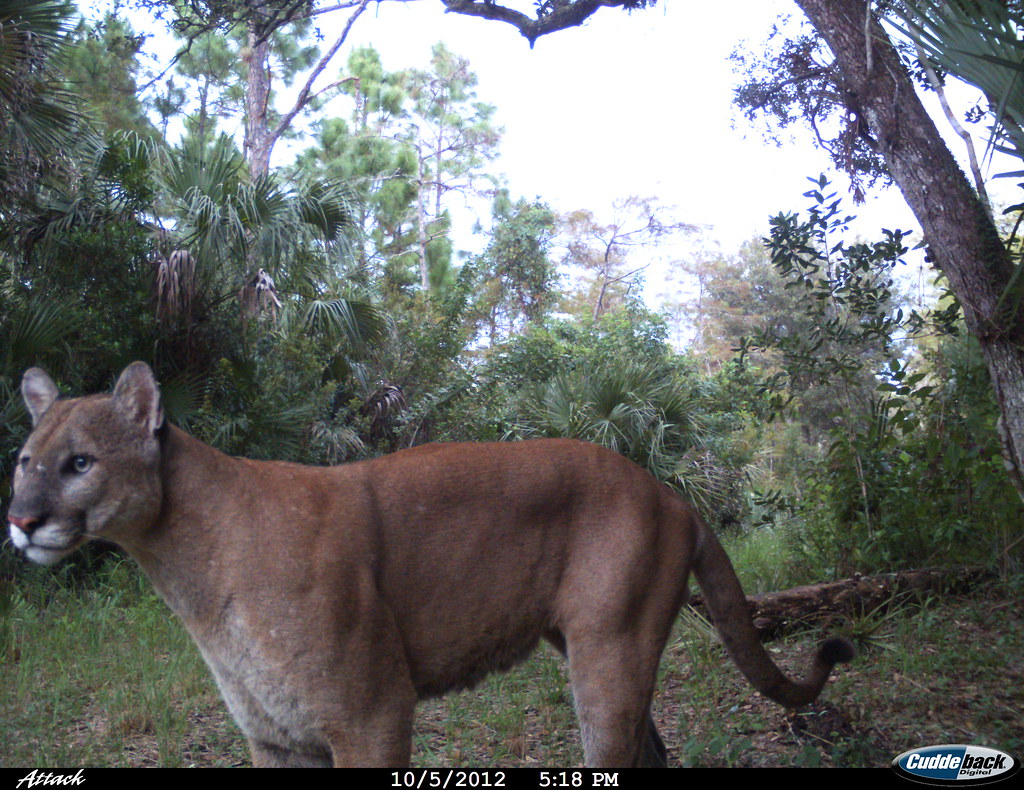
Before Genetic Rescue: How Florida Nearly Lost the Panther
The genetic-rescue story does not begin in 1995. It begins more than a century earlier, when Florida treated panthers as animals to eliminate rather than wildlife to conserve. By the time systematic research finally began, the surviving population had already been reduced to a tiny remnant.
A Timeline of Persecution, Protection, Rediscovery, and Research
- 1832 — County bounty payments begin: Before Florida was even a state, its territorial legislature authorized payments by county courts for killing panthers. This was not population monitoring. It was government-supported predator removal.
- 1887 — The statewide bounty era: Florida established a statewide bounty of $5 per panther pelt. Rather than counting panthers in order to protect them, the state created a direct financial incentive to kill them. Hunting and persecution continued as the population contracted into increasingly remote parts of Florida.
- 1930s — Panthers appeared close to gone: By the 1930s, the animal had become so rare that it was widely thought to have disappeared from much of its former range, although scattered sightings and killings continued around the Big Cypress region.
- Through the unprotected decades: For generations, panthers were treated primarily as threats to livestock and competitors for game. Killing was largely unregulated. Historical records from this period document persecution and bounty programs, not anything resembling a modern statewide population census.
- 1950 — Only partial protection: By 1950 the panther was already rare. Historical recovery records indicate that it received only partial protection at that point and could still be hunted during deer season or in depredation circumstances.
- 1958 — Hunting is finally prohibited: Florida removed the panther from the list of game animals and gave it complete state protection. The Florida Department of State continues to identify 1958 as the year legal hunting protection began.
- 1967 — Federal endangered listing: The Florida panther was placed on the federal endangered species list, years before the modern Endangered Species Act of 1973.
- 1973 — Rediscovery: After years of uncertainty and fears that the panther had disappeared, a survey effort organized by the National Geographic Society documented that the animal still survived. Legendary Texas tracker Roy McBride found a female at Fisheating Creek in 1973.
- 1976 — A formal recovery structure begins taking shape: The Florida Panther Conservation Conference was held in Orlando, and a Florida Panther Recovery Team was established. Historical records describe a clearinghouse that began compiling reported panther observations.
- 1981 — Systematic research begins: State and federal wildlife agencies initiated the formal Florida panther research program. Biologists began capturing, radio-collaring, tracking, and collecting biological information from individual animals.
- Early 1990s — Only about 20 to 30 adults and subadults remained: The first decades of modern research confirmed how severe the crisis had become. The surviving population showed low genetic diversity, reproductive problems, heart defects, cryptorchidism, kinked tails, poor sperm quality, and other signs associated with extreme inbreeding.
- 1995 — Genetic rescue: Eight female Texas pumas were released into South Florida. Five reproduced, producing at least 20 kittens and permanently introducing Texas ancestry into the recovering population.
The chronology matters because it changes how we understand the phrase “pre-1995 Florida panther.” The population that entered the genetic-rescue era was not a large, untouched representation of all the genetic diversity that had historically existed across Florida and the Southeast. It was the surviving remnant of more than a century of killing, habitat loss, fragmentation, isolation, and demographic collapse.
By the time Florida had a sustained scientific program devoted to tracking its panthers, only a few dozen animals remained. Modern conservation did not begin with hundreds of carefully documented representatives of the historic population. It began with the survivors of a collapse.
We began conserving the Florida panther only after we had already lost most of the population we were trying to conserve.
That is also why the genetic question cannot be separated from the historical one. Humans first reduced and isolated the population. Then, after the remnant became dangerously inbred, humans had to restore outside gene flow to prevent that remnant from disappearing entirely.
The Genetic Rescue in Numbers
- 1995: Eight female Texas pumas were released into South Florida.
- Five reproduced: U.S. Fish and Wildlife Service records state that five of the eight produced litters and at least 20 kittens were born.
- Original management goal: The rescue plan aimed for roughly 20% admixture.
- Later genomic findings: The 2025 PNAS study found all post-translocation panthers analyzed by its local-ancestry method were admixed, with about 24% to 61% Texas ancestry.
- Florida ancestry remained: Nearly 30 years after the intervention, the study reported that the admixed animals retained on average about 59% to 80% Florida ancestry.
What Happened to the Florida Panther in 1995?
By the early 1990s, the Florida panther population had fallen below 30 animals and was geographically isolated in South Florida. The population showed severe signs associated with inbreeding, including reproductive problems, developmental abnormalities, low genetic diversity, and poor genetic health.
Wildlife managers faced a difficult choice: maintain the genetic isolation of the surviving population and risk losing it, or deliberately restore gene flow by introducing closely related pumas from outside Florida.
They chose genetic rescue. In 1995, eight female Texas pumas were released into South Florida. Five reproduced, producing at least 20 admixed kittens. Their descendants continued breeding within the Florida population.
From that point forward, Texas ancestry became part of the living Florida panther population.
The Florida panther survived. But the completely unmixed, isolated pre-1995 bloodline did not continue as an unmixed living lineage.
The 2025 Genome Study Shows How Large the Genetic Change Became
A 2025 study published in the Proceedings of the National Academy of Sciences examined whole-genome data from post-translocation Florida panthers to determine what happened after three decades of genetic rescue.
Its local-ancestry analysis inferred that all of the post-translocation Florida panthers it examined were admixed, carrying approximately 24% to 61% Texas ancestry.
Looking at the same result from the Florida side, the researchers reported that these admixed panthers retained on average roughly 59% to 80% Florida ancestry.
An animal at the low end of that estimate carries roughly 41% inferred Texas ancestry. That is approaching a near-even ancestral mixture, not a trace genetic contribution. The figures are population-genetic ancestry estimates rather than a simple pedigree percentage, but they demonstrate that the 1995 intervention substantially altered the genetic composition of the living population.
That scale is especially striking because the original genetic-restoration plan sought approximately 20% admixture. The 2025 paper notes that multiple studies subsequently documented admixture levels exceeding 50% following the translocation.
The intervention therefore did far more than add a tiny amount of outside genetic variation. Texas ancestry became a major component of at least some animals in the recovered population.
Texas Ancestry Is Present, Yet Much of the Florida Genome Survived
This does not mean Texas pumas genetically replaced Florida panthers.
The same 2025 study found that no genomic region across all sampled post-translocation panthers had been completely replaced by Texas ancestry. Researchers therefore found no evidence that the original Florida ancestry had been genetically “swamped” out of existence.
That distinction is central to understanding what genetic rescue actually accomplished.
Texas ancestry is now present, yet much of the ancestral Florida genome survived.
Those facts are not opposites. They describe the same genetic-rescue event.
The Florida genome was not erased. Florida ancestry remains extensive. Local alleles survived. But the descendants alive after the rescue are not an entirely unmixed continuation of the isolated pre-1995 population.
Do Pure Pre-1995 Florida Panthers Still Exist?
If “pure” is used in the narrow sense of a completely unmixed continuation of the isolated pre-1995 Florida lineage, the answer is no for the admixed post-rescue population described by the genomic study.
The term purebred is not the preferred technical language of population genetics, and the history of Florida panthers is itself complicated by earlier introductions and ancestry in parts of the Everglades population. Scientists more often distinguish canonical Florida ancestry from admixed ancestry.
But the underlying point remains important: after Texas pumas reproduced with Florida panthers, their descendants carried ancestry from both populations. The 2025 local-ancestry analysis found Texas ancestry throughout the post-translocation sample it examined.
That does not mean the Florida panther itself is considered extinct. Florida panthers remain alive, protected, reproducing, and genetically connected to the historic Florida population.
It means something more precise: the genetically isolated, completely unmixed pre-1995 lineage did not remain an unmixed living population after genetic rescue.
Why Did Scientists Choose Texas Pumas?
The extreme isolation of twentieth-century Florida panthers was not necessarily the natural historical condition of pumas in the Southeast.
The U.S. Fish and Wildlife Service describes historical gene exchange between Florida panthers and neighboring puma populations before persecution, habitat loss, and fragmentation separated them. The Texas animals were selected in part because they represented a closely related population that could restore gene flow without importing a distantly related animal.
In that sense, the 1995 project was intended to restore a biological process that human-caused fragmentation had interrupted.
That does not change the genetic consequence. It explains why conservationists accepted it.
Genetic Rescue Saved the Population by Ending Its Isolation
Before genetic rescue, the remnant population was trapped in a genetic bottleneck. The 2025 genomic work found that post-translocation animals had substantially greater heterozygosity and far less of their genome locked into long runs of homozygosity than canonical pre-rescue Florida panthers.
The improvement appears to have come largely from masking harmful recessive variants through increased heterozygosity rather than simply removing all deleterious genetic variants from the population.
Genetic rescue worked because it changed the genetic structure of the population.
We did not save the Florida panther by preserving its genetic isolation. We saved it by ending that isolation.
What the Florida Panther Teaches Us About Saving Florida Plants
This story reaches far beyond one endangered cat. It goes directly to the work of plant conservation and the mission of the Florida Seed Bank.
Plant populations can become isolated in exactly the same way animal populations do. A highway, subdivision, drainage project, agricultural conversion, or fragmented habitat can interrupt the movement of pollen and seeds that once connected populations.
A rare plant may survive for decades in a small preserve and still be moving toward a genetic problem. Population size alone does not tell the entire story. A population can remain physically present while losing genetic diversity generation after generation.
This is why the Florida Seed Bank’s approach to documented seed collection and long-term preservation must consider more than a species name. Where a collection came from matters. The population it represents matters. Genetic diversity matters.
Seed Provenance Preserves Choices
Imagine a Florida native plant that survives in four isolated populations. If seeds from all four populations are mixed together without records, conservationists may lose information that can never be reconstructed.
But if those populations are collected, documented, and preserved separately, future scientists retain options.
They may discover that one population contains valuable drought tolerance. Another may carry cold tolerance. A third may contain disease resistance. A fourth may represent an unusual local lineage worth maintaining separately.
Or one population may someday become so small and inbred that carefully managed gene flow from another compatible population becomes necessary.
Good provenance records allow future conservationists to make that decision knowingly rather than blindly.
What Population-Level Seed Banking Should Preserve
- Collection location: Where the seed originated, documented at an appropriate conservation level.
- Population identity: Which distinct wild population the collection represents.
- Parent diversity: Seeds collected across an appropriate number of parent plants rather than from a single individual whenever conservation protocols allow.
- Habitat context: Ecological conditions associated with the source population.
- Collection date and methods: Records that allow future researchers to understand the material.
- Separate accessions: Distinct populations preserved separately when biologically and operationally appropriate.
- Future genetic information: Genetic documentation added when resources and research partnerships make it possible.
Preservation Should Come Before Genetic Rescue
Genetic rescue is a powerful conservation tool, but it is an intervention used after options have already narrowed.
Seed banking gives plant conservationists an opportunity to act earlier.
By preserving material from multiple populations while they still exist, a conservation program can retain genetic variation before development, storms, freezes, disease, invasive species, or simple demographic decline remove it from the landscape.
That principle is part of the broader conservation work described in Florida Seed Bank’s mission and is directly relevant to restoration projects such as the Central Florida Sandhill Conservation Pilot.
The objective is not to mix every population together. It is the opposite: preserve enough information and genetic material that future conservationists can choose whether populations should remain separate, be restored independently, or—only when justified—participate in carefully managed gene flow.
Conservation Is About Preserving Evolutionary Options
The Florida panther presents a question that will become increasingly common as habitats fragment and populations shrink:
What exactly are we trying to save?
A species name? A particular population? A local genome? An ecological role? A lineage? Or the ability of that lineage to continue adapting and evolving?
Ideally, conservation preserves all of them. Reality sometimes forces a choice.
Florida panther managers chose survival over continued genetic isolation. The decision retained much of the ancestral Florida genome and improved the population’s immediate genetic health, but it also permanently incorporated Texas ancestry into the population.
At the low end of the 2025 study’s Florida-ancestry estimates, approximately 59% Florida ancestry means roughly 41% inferred Texas ancestry. That is substantial. It should not be minimized when explaining what genetic rescue did.
Yet the Florida genetic legacy was not erased either. No genomic region was found to have been completely replaced by Texas ancestry across all sampled post-translocation panthers.
Texas ancestry is now deeply incorporated into living Florida panthers, yet much of the ancestral Florida genome survived.
That is the paradox—and the accomplishment—of genetic rescue.
The Lesson for Florida Seed Bank
For the Florida Seed Bank, the lesson is straightforward: preserve genetic options before an emergency removes them.
Preserve seeds from multiple populations. Preserve provenance. Document the source. Keep biologically meaningful collections distinct. Support habitat protection so stored material remains a backup rather than a replacement for functioning wild ecosystems.
Our seed preservation work is therefore not only about preventing a species name from disappearing. It is about helping preserve the genetic diversity that gives Florida’s native plants the capacity to survive change.
Because once a population disappears, its unique genetic variation may disappear with it. And once an isolated lineage is merged through genetic rescue, its previous genetic condition cannot simply be recreated.
The Florida panther survived because conservationists acted before the population vanished. Florida’s native plants deserve the same foresight—while we still have more than one option left.
Sources & Further Reading
- Aguilar-Gómez, D. et al. (2025). “Genetic rescue of Florida panthers reduced homozygosity but did not swamp ancestral genotypes.” Proceedings of the National Academy of Sciences. Read the open-access study.
- U.S. Fish and Wildlife Service. “Florida Panther and the Genetic Restoration Program.” Read the federal genetic-restoration factsheet.
- University of Florida IFAS Extension. “The Florida Panther: Past, Present, and Future.” Documents the 1973 rediscovery, the 1981 research program, the early-1990s population estimate of roughly 20 to 30 adults and subadults, and the 1995 genetic restoration. Read the UF/IFAS overview.
- National Geographic. “The History of the Florida Panther, A Symbol of Reverence and Revulsion.” Documents the statewide $5 bounty beginning in 1887, the decline by the 1930s, the 1958 hunting prohibition, and Roy McBride’s 1973 discovery of a female at Fisheating Creek. Read the historical overview.
- Florida Department of State. “State Animal — Florida Panther.” Notes that the panther has been protected from legal hunting in Florida since 1958. Read the state history.
- National Parks Conservation Association. “Saving the Panther.” Reviews the 1973 rediscovery and the controversy surrounding the 1995 Texas-puma introduction. Read the NPCA history.