Florida’s forests are home to orchids that never need soil at all. One of the best known is Encyclia tampensis, the Florida butterfly orchid, a native epiphyte that grows on tree trunks and branches where its roots are exposed to rain, humidity, moving air, and filtered sunlight.
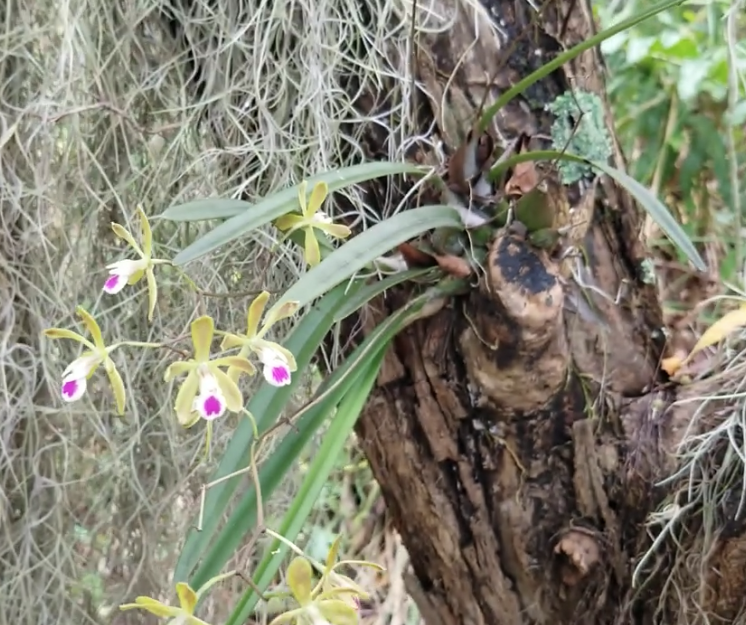
Its flowers are easy to recognize. Slender yellow-green to bronze petals and sepals spread outward around a pale lip marked with vivid pink or purple. A mature plant can produce branching flower spikes carrying many blooms, creating a display that looks surprisingly delicate for an orchid adapted to Florida’s heat, storms, droughts, and seasonal changes.
But the real story of Encyclia tampensis is not only its flowers. Its roots, pseudobulbs, host trees, pollinators, fungi, and surrounding habitat all reveal how specialized native orchids can be — and why conserving an orchid means protecting far more than the bloom.
Meet the Florida Butterfly Orchid
- Scientific name: Encyclia tampensis.
- Common name: Florida butterfly orchid.
- Growth habit: Epiphytic — it naturally grows attached to trees and other above-ground surfaces.
- Flowers: Star-shaped blooms with yellow-green to bronze segments and a white lip marked with pink or purple.
- Roots: Adapted to excellent airflow and rapid drainage rather than constantly wet soil.
- Florida connection: It is part of the native orchid flora that makes the state’s subtropical and warm-temperate habitats biologically distinctive.
What Does “Epiphytic” Mean?
An epiphyte grows on another plant for physical support without feeding on that plant. The tree is a place to live, not a food source.
In the wild, a butterfly orchid may anchor itself to rough bark where its roots can catch rainfall, dissolved nutrients, dust, decaying organic material, and moisture from the humid air. Those roots also dry quickly after becoming wet.
That wet-dry rhythm is important. It explains why a native orchid that survives Florida thunderstorms can still suffer in cultivation if its roots are packed into a dense, constantly wet medium.
A Florida butterfly orchid does not need soil beneath its roots. It needs air around them.
Pseudobulbs: The Orchid’s Built-In Reserve
Encyclias typically form pseudobulbs — swollen stem structures that store water and nutrients. Leaves emerge from these structures, and new growths develop as the plant expands into a clump.
Pseudobulbs are one reason established plants can tolerate brief dry periods better than their delicate flowers might suggest. They are part of an epiphytic survival strategy in which water can be abundant one day and limited the next.
Light: Bright, but Not Reckless
Encyclia tampensis generally performs best with strong light and good air movement. In nature, that can mean filtered sun through an open tree canopy or brighter exposure along the edges of hammocks, woodlands, and other suitable habitat.
For cultivated plants, bright filtered light and gentle morning sun are often useful starting points. A plant moved suddenly from shade into intense Florida midday sun can burn, so changes in exposure should be gradual.
Plants kept too dark may remain alive while flowering poorly. The objective is not maximum sun. It is enough light to support strong growth without scorching the foliage.
Water: Soak, Drain, Breathe
When watering a cultivated Encyclia, thoroughly wet the roots and then allow them to approach dryness before watering again. How quickly that happens depends on temperature, humidity, airflow, mounting method, season, and the size of the plant.
A mounted orchid can dry much faster than the same orchid in a basket. Florida’s summer rains may also reduce the need for supplemental watering, while cooler or drier periods can change the plant’s rhythm.
The most important principle is drainage. Encyclia roots should not remain trapped in stagnant, waterlogged conditions.
Air Movement Is Part of Orchid Care
Airflow is not an optional detail for an epiphytic orchid. It helps wet roots dry, reduces persistently damp leaf surfaces, and more closely recreates life on an exposed branch.
Outdoors, natural breezes can provide excellent circulation. In protected growing areas, baskets and mounts should be spaced so air can move around the plants rather than being blocked by dense foliage or tightly packed containers.
Flowers That Look Delicate but Belong to Florida
The Florida butterfly orchid produces slender, star-like flowers that can vary somewhat in color from plant to plant. The contrast between the narrow yellow-green or bronze floral segments and the bright white-and-purple lip gives the blooms their unmistakable character.
Mature specimens can produce impressive sprays, and many Encyclias are noted by growers for fragrance. Blooming is more than an ornamental event: in the wild, flowers are part of the plant’s reproductive relationship with pollinating insects and the surrounding ecosystem.
How to Grow Encyclias in a Florida-Friendly Way
The closer cultivation comes to the orchid’s natural epiphytic conditions, the easier its needs are to understand. Rather than thinking of it as a conventional potted plant, think about bark, airflow, drainage, humidity, light, and seasonal rainfall.
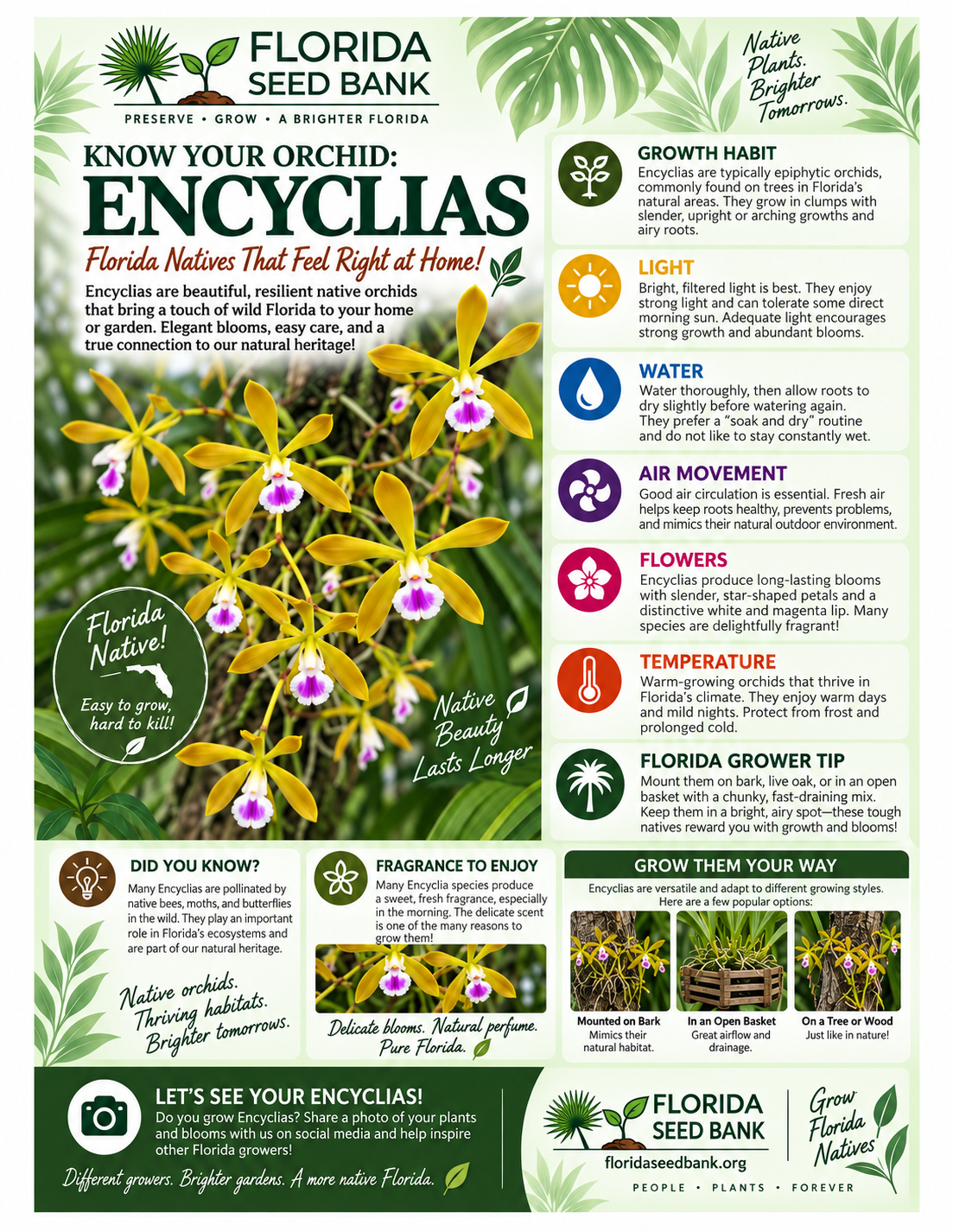
Three Useful Growing Approaches
- Mounted on bark: A mount allows roots to remain exposed and dry rapidly after watering.
- In an open basket: A slatted basket can provide support while maintaining excellent airflow and drainage.
- Mounted to an appropriate landscape tree: In suitable climates and legally sourced cultivation, an orchid may establish on bark much as an epiphyte would in nature.
Whichever method is used, avoid burying the plant in ordinary garden soil. A cultivated orchid should also be monitored during unusually cold weather. Being native to Florida does not mean every individual is immune to frost, especially when a plant is exposed, newly established, or grown outside the warmer portions of its natural climatic range.
Why Native Orchids Should Never Be Taken From the Wild
A flowering orchid on a tree may look abundant, but a visible plant can represent years of development and a much larger network of ecological relationships that cannot be carried home with it.
Removing wild orchids can damage local populations, eliminate reproductive plants, and sever the plant from the habitat conditions that allowed it to establish in the first place.
Anyone who wants to cultivate Florida native orchids should obtain legally propagated plants from reputable nurseries or growers. Wild orchids should be photographed, documented when appropriate, and left where they are.
An Orchid Seed Is Almost Dust
Orchid conservation becomes especially interesting when seeds enter the story. Orchid seeds are extraordinarily small and contain very little stored food compared with the seeds of many familiar plants.
In nature, germination commonly depends on relationships with compatible fungi. Those fungi can provide resources that allow the tiny embryo to begin developing before it can support itself through photosynthesis.
This is why propagating orchids from seed is fundamentally different from sowing a tray of wildflower seed. Successful orchid conservation may require sterile flasking techniques, carefully developed germination protocols, knowledge of fungal partners, and long periods of growth before plants are mature enough for conservation or restoration work.
Why Orchid Conservation Is More Than Seed Storage
Conventional conservation seed banking is an extraordinary tool, but orchids remind us that every species has its own biology.
For native orchids, a strong conservation program may eventually combine seed storage with germination trials, tissue culture or flask propagation, fungal research, genetic documentation, living collections, habitat monitoring, and carefully planned restoration.
None of those tools replaces habitat.
A freezer cannot recreate a mature host tree, seasonal rainfall, pollinator activity, fungal communities, or the microclimate of a Florida forest. Ex-situ conservation is most powerful when it operates as a backup to healthy wild populations rather than as a substitute for them.
Saving a native orchid means protecting the plant, its genetics, and the ecological relationships that allow it to exist.
Host Trees Matter — but the Orchid Is Not Feeding on Them
Epiphytic orchids are often associated with particular kinds of bark, branch structure, humidity, canopy openness, or forest conditions. Yet an orchid growing on a tree is not consuming the tree.
The distinction matters because epiphytes are sometimes misunderstood as harmful growths. In reality, the orchid is using the tree as architecture. Its roots attach to the surface while the plant obtains water and nutrients from its surrounding environment.
Protecting mature trees can therefore indirectly protect orchid habitat by preserving the physical surfaces and microclimates on which epiphytes establish.
Native Orchids Can Connect Horticulture and Conservation
Legally propagated native orchids have another conservation value: they help people recognize what belongs in Florida.
Someone who grows an Encyclia tampensis may begin noticing epiphytes in natural areas, learning the difference between native and introduced orchids, understanding why mature trees matter, or becoming interested in the fungi and pollinators involved in orchid reproduction.
That knowledge can change the way people see a forest. What first looked like “a tree with something growing on it” becomes a layered habitat supporting multiple species.
Florida’s Native Orchid Heritage Is Worth Preserving
The Florida butterfly orchid is beautiful enough to attract attention, but beauty is only the beginning.
Encyclia tampensis represents a form of plant life adapted to Florida’s humidity, rainfall, trees, insects, fungi, and seasonal rhythms. Its exposed roots and airborne seeds tell a very different story from plants rooted in the ground.
Learning how it lives helps explain how we should grow it — and, more importantly, how we should protect it.
Florida Seed Bank’s broader mission is to preserve the genetic diversity of Florida’s native flora while supporting the science, propagation knowledge, habitat protection, and restoration work needed to keep those plants functioning in the wild.
Native orchids make that mission especially clear: conservation is not simply about saving something beautiful. It is about preserving the biological relationships that make Florida Florida.
Remember These Encyclia Basics
- Give the roots abundant air and fast drainage.
- Provide bright light while avoiding abrupt exposure to harsh sun.
- Water thoroughly, then allow the roots to dry somewhat.
- Use mounts or open baskets that reflect the orchid’s epiphytic growth habit.
- Protect cultivated plants from damaging cold and frost.
- Buy legally propagated native orchids and never remove plants from the wild.
- Remember that conserving orchids also means conserving habitat, host trees, pollinators, fungi, and genetic diversity.