Florida has just gained something remarkable: recognition of its first carnivorous plant species known to occur naturally nowhere else on Earth.
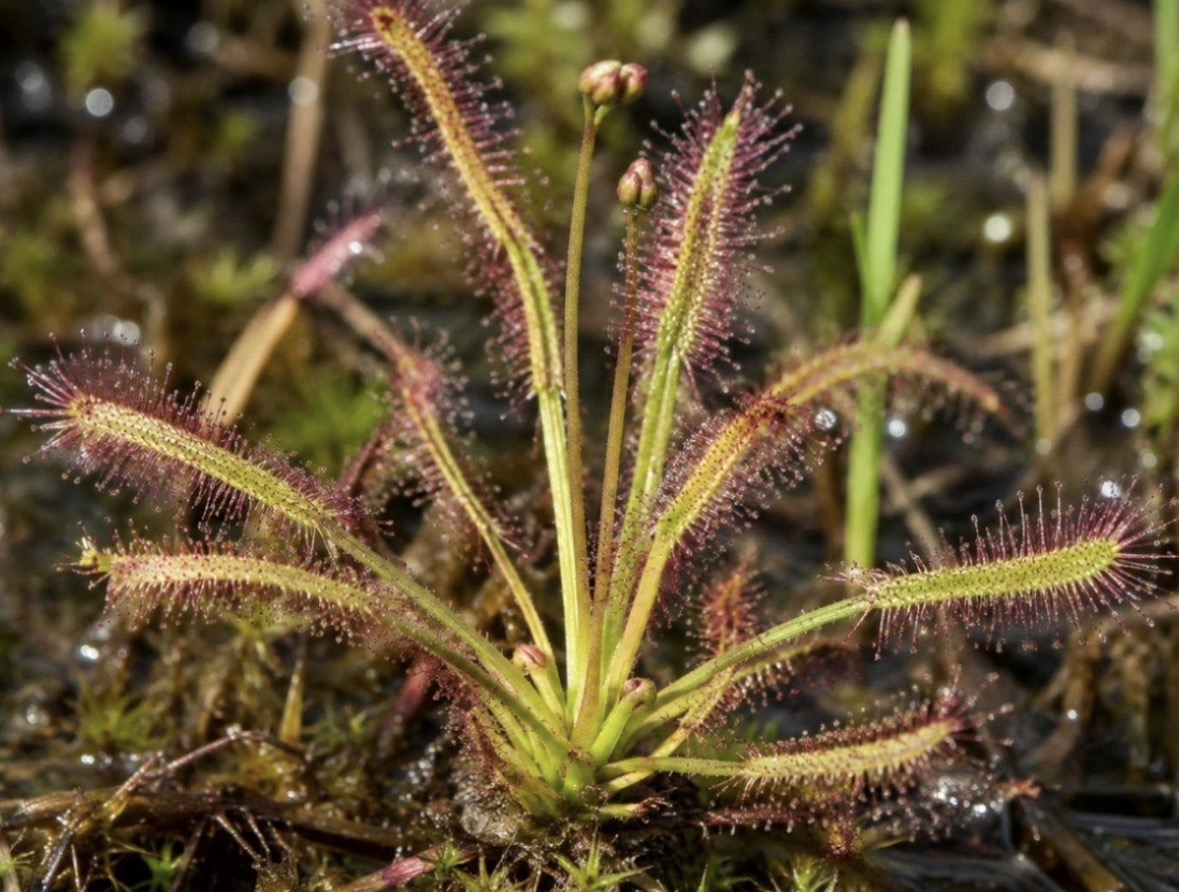
Drosera floridana is a carnivorous sundew endemic to Florida. It is not simply a plant that happens to occur in the state: its entire known natural distribution is restricted to a very small portion of Bay and Washington counties in the Florida Panhandle.
That makes it one of Florida’s most geographically restricted native plants and, according to the researchers who elevated it to species rank in 2026, the most localized sundew species on the North American continent.
For years, these plants were treated as a Florida variety of the northern thread-leaved sundew and known as Drosera filiformis var. floridana.
In 2026, botanists Nathaniel Juve and Andreas Fleischmann published a peer-reviewed taxonomic treatment recognizing the Florida plant as a distinct species: Drosera floridana (B.Rice) Juve & A.Fleischm.
The change is much more than a new name.
It means Florida now has a recognized carnivorous plant species whose natural evolutionary history is tied entirely to this state.
Why Drosera floridana Is Extraordinary
- It is a carnivorous sundew found naturally only in Florida.
- Its known range is confined to Bay and Washington counties in the Florida Panhandle.
- Researchers describe its total geographic range as only about 25 by 20 kilometers.
- It was elevated to full species rank in a peer-reviewed publication in 2026.
- Its habitat is associated with unusual littoral seepage zones around sinkhole lakes in the Econfina Karst Region.
- Its highly restricted distribution makes habitat loss or degradation especially consequential.
Florida’s Own Carnivorous Plant
Florida is famous for carnivorous plants.
Pitcherplants rise from Panhandle bogs. Butterworts spread flat leaves across wet pine savannas. Bladderworts capture microscopic prey beneath water. Several species of sundew glitter along wet roadsides, seepage slopes, pond margins, and bogs.
But most of those species also occur outside Florida.
Drosera floridana is different.
Its natural range begins and ends in Florida.
If Florida loses Drosera floridana, the world loses Drosera floridana.
That is the meaning of endemism.
An endemic species cannot be restored simply by obtaining plants from another state. There is no North Carolina population, no Georgia population, and no Alabama population waiting to replace it.
Every naturally occurring population represents part of the entire global wild population.
From a Florida Variety to a Species of Its Own
The Florida plants were not unknown before 2026.
They had long been recognized as unusual populations of the thread-leaved sundew, Drosera filiformis, and were formally described at varietal rank as Drosera filiformis var. floridana.
Botanists had already documented differences between the Florida plants and the more northerly D. filiformis, including their red to orange coloration, morphology, and dramatically separated geographic range.
Juve and Fleischmann’s 2026 treatment brought together years of field observations, morphological study, ecology, phenology, and comparisons across the thread-leaved sundews.
Their conclusion was that the Florida taxon warranted recognition as its own species.
The closest populations of the northern plant with which it had previously been grouped occur hundreds of kilometers away. Meanwhile, D. floridana occupies a distinctive ecological niche in one small part of the Florida Panhandle.
That combination of isolation, morphology, and ecology makes this more than a regional color form.
It is part of Florida’s unique botanical heritage.
A Global Range Measured in Miles
The distribution of Drosera floridana is extraordinarily small.
Researchers describe the species as being confined to an area of approximately 25 by 20 kilometers within Bay and Washington counties.
That is its global range.
Not its Florida range.
Not its United States range.
Its entire known natural range on Earth.
Older botanical records and Florida regulatory documents generally refer to these plants under the former name Drosera filiformis or D. filiformis var. floridana. Those records consistently identify Bay and Washington counties as the center of the rare Florida population.
Because Drosera floridana has such a small global range and carnivorous plants can attract collectors, precise wild population coordinates should not be casually publicized. Conservation can discuss the species’ regional distribution without directing unauthorized collection from individual sites.
A Plant Built to Catch Animals
Sundews are among the most visually striking examples of carnivory in plants.
The leaves of Drosera floridana are covered with glandular tentacles tipped with droplets of sticky mucilage.
Those glistening droplets look like morning dew, giving the genus its common name.
But the “dew” is a trap.
Small insects that land on the leaves become stuck to the adhesive surface. Additional tentacles can contact the prey, and digestive enzymes allow the plant to absorb nutrients from the captured animal.
Carnivory gives sundews an advantage in habitats where essential nutrients, particularly nitrogen and phosphorus, are scarce.
Instead of depending entirely on nutrient-rich soil, the plant supplements its nutritional needs by capturing animals.
That remarkable adaptation allows sundews to flourish in wet, acidic, nutrient-poor habitats where many larger plants struggle.
Its Habitat Is Almost as Specialized as the Plant
The rarity of Drosera floridana is not only about geography.
It is also tied to an unusually specific habitat.
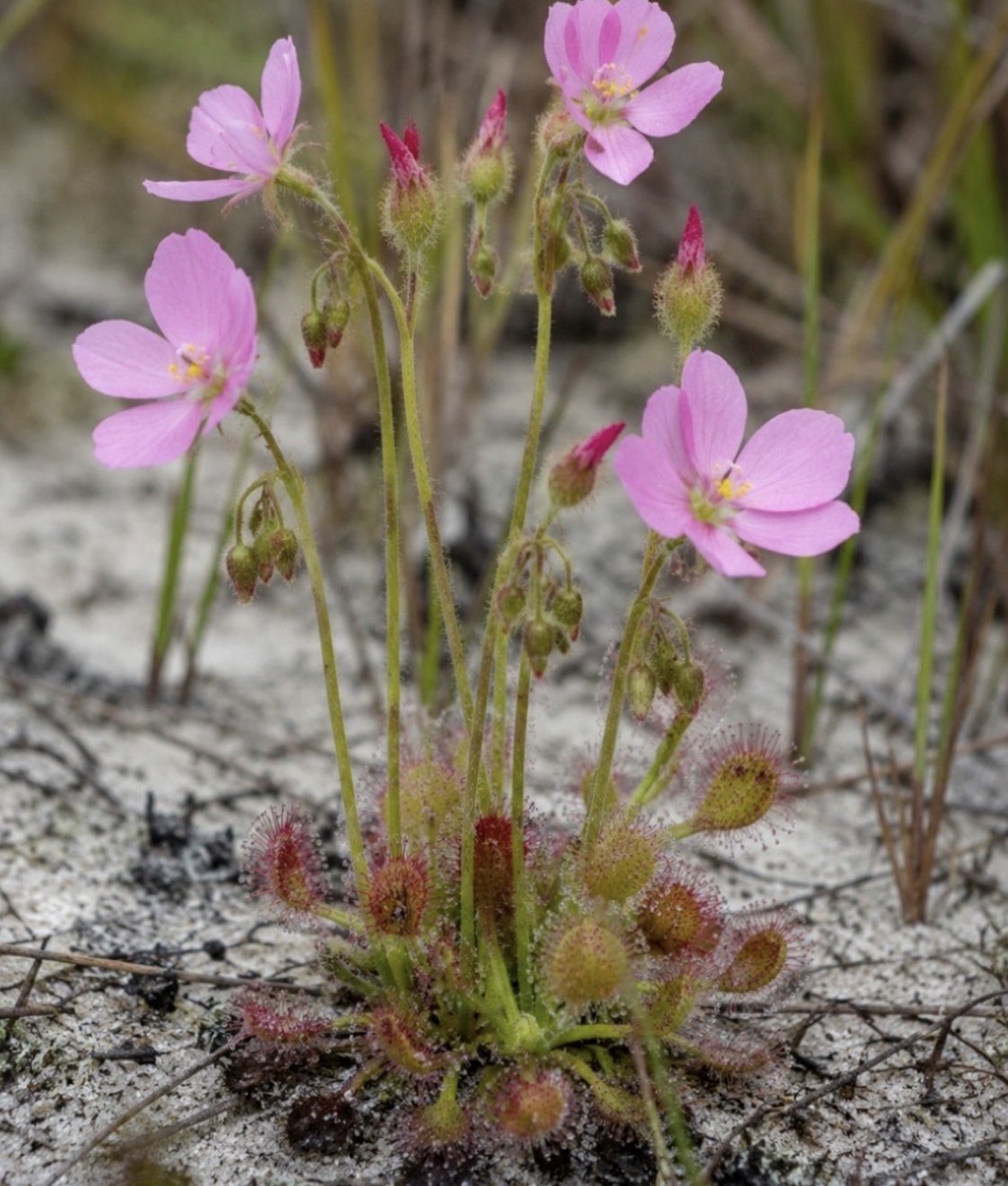
Researchers describe the species from the Econfina Karst Region, where it occurs around sinkhole lakes associated with unusual littoral seepage zones.
These seepages bring groundwater toward the margins of the lakes and create narrow transitions between wetter and drier conditions.
Drosera floridana occupies an intermediate ecological zone between habitats favored by other Florida sundews.
It frequently grows where nearly pure white quartz sand occurs near seepage veins. The surface can appear surprisingly dry even though groundwater movement below and through the sand creates the moisture regime the plant requires.
These open sandy areas also contain relatively little competing vegetation.
That matters.
A small carnivorous plant adapted to open, nutrient-poor substrates can be overwhelmed when shrubs, grasses, or woody vegetation become too dense.
Protecting the species therefore requires protecting the ecological processes that maintain its habitat, not simply drawing a boundary around individual plants.
Water Is Part of the Habitat
A seepage-dependent plant is inseparable from the hydrology supporting it.
Groundwater movement, seasonal lake levels, soil moisture, rainfall, drought, drainage, and changes to the surrounding watershed can all influence whether suitable habitat persists.
A wetland may still appear intact from a distance while subtle hydrological changes alter the narrow moisture zone required by a specialized species.
For Drosera floridana, protecting the land without understanding the water moving through it may not be enough.
Its conservation is therefore connected to the larger karst landscape.
Why Such a Small Range Creates Risk
Species with extremely restricted ranges live with a mathematical disadvantage.
A widespread plant can lose several populations while thousands of others remain elsewhere.
A species occupying only a tiny part of two neighboring counties has far less redundancy.
Local events can become global events for the species.
Threats Matter More When the Entire Range Is Small
- Hydrological alteration can change the seepage conditions that create suitable habitat.
- Development can eliminate or fragment habitat and alter surrounding groundwater movement.
- Fire suppression can allow larger vegetation to overtake open carnivorous-plant habitat.
- Drought and changing rainfall patterns can alter the delicate moisture regime around sinkhole lakes.
- Roadwork, ditching, soil disturbance, or drainage can affect small populations disproportionately.
- Unauthorized collection can remove genetically important plants from already limited populations.
- A hurricane or other major disturbance can affect a large fraction of a narrowly concentrated global range at once.
Its Endangered Status and a New Name
There is an important regulatory detail surrounding this newly recognized species.
Florida’s endangered-plant records were developed while these Panhandle populations were still generally treated taxonomically as Drosera filiformis.
The Florida Department of Agriculture and Consumer Services lists the rare Florida thread-leaved sundew under the older nomenclature in its endangered plant materials and identifies Bay and Washington counties in its distribution.
Because the elevation of Drosera floridana to species rank was published only in 2026, regulatory databases and state lists may take time to reflect the new scientific name.
That nomenclatural lag should not be confused with a change in conservation need.
These are the same exceptionally restricted Florida populations that conservationists were already concerned about — now recognized as an endemic species in their own right.
Florida law also regulates harvesting of listed endangered plants from the wild, and collecting protected plants requires appropriate authorization.
A Newly Named Species Can Already Be in Trouble
The recognition of a species is sometimes described as a “discovery.”
But Drosera floridana did not suddenly appear in 2026.
It had been growing beside Florida Panhandle sinkhole lakes long before botanists gave it its current name.
The new taxonomic recognition instead changes how we understand what could be lost.
If these populations disappear, Florida would not merely lose the southernmost populations of a more widespread northern sundew.
It would lose an entire species.
Scientific recognition does not make a plant rare. It reveals how rare the plant already was.
The Hidden Conservation Target Is Genetic Diversity
As with other rare plants, preserving Drosera floridana cannot be reduced to counting individual plants.
Populations contain genetic variation.
Plants growing around different lakes, seepage zones, or portions of the species’ range may not be genetically identical.
Some may carry traits that influence drought tolerance, flowering time, dormancy, disease resistance, temperature response, or adaptation to slightly different hydrological conditions.
Losing one population can therefore mean losing genetic combinations that are not represented elsewhere.
This is especially important when the entire species already occupies such a small area.
Why Seed Conservation Matters
A species like Drosera floridana demonstrates why conservation seed banking must focus on narrowly endemic plants before populations reach the edge of extinction.
Wild habitat must remain the first line of defense.
Seed storage cannot reproduce a functioning seepage system, a sinkhole lake, native pollinators, natural fire, hydrology, or the web of organisms surrounding a wild population.
But an appropriately designed conservation collection can create another line of defense.
Seed collected legally and scientifically from multiple populations and multiple maternal plants can preserve genetic material outside the immediate path of local habitat loss.
It can support germination research, propagation, genetic study, population reinforcement, and — if habitat is ever lost and later restored — carefully planned reintroduction.
One Collection Is Not Enough
A narrowly endemic species demands careful sampling.
Collecting a large quantity of seed from one patch would not adequately represent the species.
A meaningful conservation program should document genetic and geographic representation across the surviving populations without jeopardizing natural reproduction.
A Strong Conservation Collection Should Preserve
- Seed from multiple maternal plants rather than a single individual.
- Material representing multiple populations across the known range where legally and scientifically appropriate.
- Exact provenance retained privately for scientific use while sensitive public locations remain protected.
- Collection dates, habitat conditions, flowering and fruiting observations, and population notes.
- Seed viability and germination data.
- Duplicate accessions in geographically separated storage facilities.
- Enough material for future research without depriving wild populations of natural recruitment.
The purpose is not to build the largest possible jar of sundew seed.
The purpose is to preserve a scientifically useful representation of the species.
Fire, Open Habitat, and Competition
Many of Florida’s carnivorous plant communities are associated with landscapes shaped by recurring fire.
Fire can suppress woody vegetation, recycle nutrients, maintain open sunny conditions, and prevent taller plants from overwhelming low-growing specialists.
The precise management requirements of Drosera floridana must be guided by site-specific science, hydrology, and land-management expertise.
But the larger lesson is clear: rare plants often depend on ecological processes, not simply acreage.
Protecting land while allowing the habitat to fundamentally change can still result in species loss.
The Florida Panhandle Is a Biodiversity Stronghold
Discussions of Florida biodiversity often focus on the Everglades, the Keys, or subtropical South Florida.
But the Panhandle contains some of the richest plant communities in North America.
Longleaf pine savannas, seepage slopes, pitcherplant bogs, wet prairies, karst lakes, and other habitats support extraordinary concentrations of native plants.
Many reach Florida from the north or west.
Others evolved into highly localized forms within the Panhandle itself.
Drosera floridana is now one of the clearest examples.
Its recognition reminds us that Florida still contains biological diversity that science is actively working to understand.
Protect the Habitat Before We Need the Backup
The ideal future for Drosera floridana is not one in which the species survives only in seed-bank freezers or cultivated collections.
The goal is thriving wild populations occupying functioning natural habitats in Bay and Washington counties.
Seed conservation should exist behind those populations as insurance, research material, and a recovery tool.
That requires several strategies working together:
Multiple Lines of Defense
- Protect remaining wild populations and the land surrounding them.
- Protect groundwater and hydrological conditions supporting seepage habitat.
- Maintain appropriate disturbance and vegetation structure through science-based land management.
- Prevent unauthorized collection from the wild.
- Monitor populations and document changes over time.
- Preserve representative seed and genetic material before populations are lost.
- Develop propagation and germination knowledge while healthy wild populations still exist.
- Store duplicate conservation material in geographically separated locations.
A Species the World Entrusts Entirely to Florida
There is a special responsibility that comes with an endemic species.
Every wild Drosera floridana population occurs within Florida.
Its habitat is Florida habitat.
Its surviving genetics are Florida genetics.
Its future depends on decisions made here.
The species survived for generations without being recognized at full species rank. Science has now given us a clearer understanding of what those small Panhandle populations represent.
We should use that knowledge while we still have something to protect.
Florida does not merely contain part of the range of Drosera floridana. Florida contains all of it.
Why Florida Seed Bank Is Paying Attention
Florida Seed Bank was created around a simple principle: conservation should begin before disappearance.
Species with tiny ranges are exactly where proactive seed conservation can matter most.
The strongest conservation response begins while populations are still healthy: identify and document them, understand their genetics, preserve provenance, study seed-storage behavior, develop germination protocols, maintain duplicate conservation material, and coordinate any sensitive work with the appropriate land managers, researchers, agencies, permits, and scientific expertise.
Drosera floridana is not simply another beautiful carnivorous plant.
It is a species whose entire natural existence is concentrated into a tiny portion of North Florida.
In August 2026, science gave that plant a clearer identity.
Florida now has the responsibility to ensure that recognition is not followed by disappearance.
Sources and Further Reading
- Juve & Fleischmann (2026): The Florida endemic sundew Drosera floridana elevated to species rank
- LMU Munich: Andreas Fleischmann publications
- NatureServe Explorer: Florida threadleaf sundew under its previous varietal treatment
- Florida Department of Agriculture and Consumer Services: Florida regulated endangered and threatened plants
- Florida Wildflower Foundation: Florida’s carnivorous plants and sundews